Saturday, April 28, 2001

2001 Nebula Award Nominees

Location: Beverly Hilton Hotel, Beverly Hills, California.

Comments: In the second year in a row that the Nebula Award for Best Script was given out, the movie Galaxy Quest won the prize. It is perhaps a mark of how influential the Star Trek franchise is that a parody that pokes fun at it would win a Nebula award. What is really interesting about the selection of Galaxy Quest as the Nebula winner is that the original source material that inspired it was never even nominated for a Nebula Award. Not the original show, not the Next Generation spin-off. Not the Deep Space Nine or Voyager spin-offs. Certainly not the often overlooked but still quite good animated series. And not any of the movies, either featuring the classic cast or cast members of more recent vintage. Star Trek, it seems, is strong enough to engender a Nebula-winning parody, but not strong enough on its own to even get a nomination.

As is typical in many Nebula years, the Best Novel category was fairly uninteresting, as a good book won the award over a collection of other good books. In the Best Novella category, the most interesting thing for me wasn't the winner, but rather the story Ninety Percent of Everything, a title that was clearly an homage to Theodore Sturgeon who famously opined that "Ninety percent of everything is crud". The thing that I wonder about the story is why it took three authors to write a single novella. It seems like a little bit of overkill to have three authors on a story that, by definition, is less than 40,000 words. Then again, I'm not a published author, so maybe there was a good reason they needed to do that.

Best Novel

Winner:
Darwin's Radio by Greg Bear

Other Nominees:
A Civil Campaign by Lois McMaster Bujold
Crescent City Rhapsody by Kathleen Ann Goonan
Forests of the Heart by Charles de Lint
Infinity Beach by Jack McDevitt
Midnight Robber by Nalo Hopkinson

Best Novella

Winner:
Goddesses by Linda Nagata

Other Nominees:
Argonautica by Walter Jon Williams
Crocodile Rock by Lucius Shepard
Fortitude by Andy Duncan
Hunting the Snark by Mike Resnick
Ninety Percent of Everything by Jonathan Lethem, James Patrick Kelly, and John Kessel

Best Novelette

Winner:
Daddy's World by Walter Jon Williams

Other Nominees:
A Day's Work on the Moon by Mike Moscoe
Generation Gap by Stanley Schmidt
How the Highland People Came to Be by Bruce Holland Rogers
Jack Daw's Pack by Greer Gilman
A Knight of Ghosts and Shadows by Gardner Dozois
Stellar Harvest by Eleanor Arnason

Best Short Story

Winner:
macs by Terry Bisson

Other Nominees:
The Fantasy Writer's Assistant by Jeffrey Ford
Flying Over Water by Ellen Klages
The Golem by Severna Park
Scherzo with Tyrannosaur by Michael Swanwick
You Wandered Off Like a Foolish Child To Break Your Heart and Mine by Pat York

Best Script

Winner:
Galaxy Quest by David Howard and Robert Gordon

Other Nominees:
Being John Malkovich by Charlie Kaufman
Dogma by Kevin Smith
The Green Mile by Frank Darabont
Princess Mononoke by Hayao Miyazaki and Neil Gaiman
Unbreakable by M. Night Shyamalan

Ray Bradbury Award

Winner:
2000X - Tales of the Next Millennia

Other Nominees:
None

Go to previous year's nominees: 2000
Go to subsequent year's nominees: 2002

Book Award Reviews     Home

Sunday, December 31, 2000

2000 Campbell Award Nominees

Location: Campbell Conference Awards Banquet at the University of Kansas in Lawrence, Kansas.

Comments: After four years of "normal" (or what passes for normal for the Campbell Awards), the judges decided they were not content with just reporting the first, second, and third place finishers, but that they needed to throw yet another procedural curveball and add a category of "honorable mentions". Why? I have no idea. The two novels that appear in this reinstated category are both decent, but neither is compelling enough that it's existence would demand a change to how the award results are reported. I can only chalk this change up to the judges deciding that it is yet again time to screw with everyone's head.

Best Novel

Winner:
A Deepness in the Sky by Vernor Vinge

Second Place:
Darwin's Radio by Greg Bear

Third Place:
Greenhouse Summer by Norman Spinrad

Honorable Mention:
The Silicon Dagger by Jack Williamson
Starfish by Peter Watts

Go to previous year's nominees: 1999
Go to subsequent year's nominees: 2001

Book Award Reviews     Home

2000 Mythopoeic Award Nominees

Location: Unknown.

Comments: In 2000 the Mythopoeic Awards reached a new height in incestuous self-referential nominations when not one, but two works by J.R.R. Tolkien were nominated in the Inklings Studies category. Granted, the Mythopoeic Society exists to honor the members of the Inklings and to award scholarship about their work and their lives, but it always seems to me like a massive conflict of interest when they nominate works that are actually written by members of the Inklings, even if they include some amount of scholarly commentary by other authors.

Best Adult Fantasy Literature

Winner:
Tamsin by Peter S. Beagle

Other Nominees:
The Book of Knights by Yves Meynard
Dark Cities Underground by Lisa Goldstein
Elementals: Stories of Fire and Ice by A.S. Byatt
The Wild Swans by Peg Kerr

Best Children's Fantasy Literature

Winner:
The Folk Keeper by Franny Billingsley

Other Nominees:
The Circle of Magic (Sandry's Book, Tris's Book, Daja's Book, and Briar's Book) by Tamora Pierce
Harry Potter and the Prisoner of Azkaban by J.K. Rowling
Kingdom (Jackaroo, On Fortune's Wheel, The Wings of a Falcon, and Elske) by Cynthia Voigt
Skellig by David Almond

Scholarship Award in Inklings Studies

Winner:
Roverandom by J.R.R. Tolkien, edited by Wayne G. Hammond and Christina Scull

Other Nominees:
C.S. Lewis: Writer, Dreamer & Mentor by Lionel Adey
Farmer Giles of Ham by J.R.R. Tolkien, edited by Wayne G. Hammond and Christina Scull
Tolkien: Man and Myth - A Literary Life by Joseph Pearce

Myth and Fantasy Studies

Winner:
Strange and Secret Peoples: Fairies and Victorian Consciousness by Carole G. Silver

Other Nominees:
King Arthur in America by Alan Lupack and Barbara Tepa Lupack
Oz and Beyond: The Fantasy World of L. Frank Baum by Michael O. Riley
The Quest for the Grail: Arthurian Legend in British Art 1840-1920 by Christine Poulson
When Dreams Came True: Classical Fairy Tales and Their Tradition by Jack Zipes

Go to previous year's nominees: 1999
Go to subsequent year's nominees: 2001

Book Award Reviews     Home

2000 World Fantasy Award Nominees

Location: World Fantasy Convention, Corpus Christi, Texas.

Comments: Gender equity is a slippery thing. An array of nominees can look, at first glance, to be somewhat equitable, but as we've been conditioned to see actual equality as domination by women, appearances can be deceiving. The 2000 World Fantasy Award ballot is a case in point. Twenty-nine different people were nominated for fiction awards in this year, but only eight of those people were women. Granted, Terry Windling and Ellen Datlow were nominated twice, so one might argue that the proper ratio of women nominees to total nominees is actually ten and thirty-one. Either way, this ratio should have embarrassed the World Fantasy Awards. There had certainly been improvement from the dark days of the 1970s when the entire female sex would often be represented by a single nomination, but when women only make up one-quarter to one-third of your nominees in the year 2000, you still have a way to go.

Best Novel

Winner:
Thraxas by Martin Scott

Other Nominees:
Gardens of the Moon by Steven Erikson
The Rainy Season by James P. Blaylock
A Red Heart of Memories by Nina Kiriki Hoffman
Tamsin by Peter S. Beagle
A Witness to Life by Terence M. Green

Best Novella

Winner:
(tie) Sky Eyes by Laurel Winter
(tie) The Transformation of Martin Lake by Jeff VanderMeer

Other Nominees:
Crocodile Rock by Lucius Shepard
Scarlet and Gold by Tanith Lee
The Winds of Marble Arch by Connie Willis
The Wizard Retires by Michael Meddor

Best Short Fiction

Winner:
The Chop Girl by Ian R. MacLeod

Other Nominees:
Amerikanski Dead at the Moscow Morgue by Kim Newman
The Dynasters Vol. 1: On the Downs by Howard Waldrop
The Grammarian's Five Daughters by Eleanor Arnason
Human Bay by Robert Reed
Naming the Dead by Paul J. McAuley
The Parwat Ruby by Delia Sherman

Best Anthology

Winner:
Silver Birch, Blood Moon edited by Ellen Datlow and Terri Windling

Other Nominees:
999: New Stories of Horror and Suspense edited by Al Sarrantonio
Dark Detectives: Adventures of the Supernatural Sleuths edited by Stephen Jones
Northern Frights 5 edited by Don Hutchison
The Year's Best Fantasy and Horror: Twelfth Annual Collection edited by Ellen Datlow and Terri Windling

Best Collection

Winner:
(tie) Moonlight and Vines by Charles de Lint
(tie) Reave the Just and Other Tales by Stephen R. Donaldson

Other Nominees:
Deep Into That Darkness Peering by Tom Piccirilli
Hearts in Atlantis by Stephen King
Necromancies and Netherworlds: Uncanny Stories by Darrell Schweitzer and Jason van Hollander

Lifetime Achievement

Winner:
Marion Zimmer Bradley
Michael Moorcock

Other Nominees:
None

Best Artist

Winner:
Jason van Hollander

Other Nominees:
Les Edwards
Bob Eggleton
Stephen E. Fabian

Special Award, Professional

Winner:
Gordon van Gelder

Other Nominees:
John Betancourt
Seamus Heaney
Stephen Jones
Warren Lapine
Kim Newman

Special Award, Non-Professional

Winner:
The British Fantasy Society

Other Nominees:
Ken Abner
Rosemary Pardoe
Philip J. Rahman and Dennis E. Weiler
R.B. Russell
William K. Schafer

Go to previous year's nominees: 1999
Go to subsequent year's nominees: 2001

Book Award Reviews     Home

2000 Clarke Award Nominees

Location: United Kingdom.

Comments: One interesting thing about the Clarke Awards is how much the nominees lists seem to favor hard science fiction. Stephen Baxter, one of the hardest of hard science fiction authors, holds the record for the most nominations. This year's nominee's include Neal Stephenson's Cryptonomicon, a hard science fiction story about code breakers, and Vernor Vinge's hard science fiction space opera A Deepness in the Sky. This year's winner - Bruce Sterling's Distraction - is also an example of hard science fiction. I suppose this is fitting, as much of Clarke's work can best be described as being part of this subgenre.

Winner
Distraction by Bruce Sterling

Shortlist
The Bones of Time by Kathleen Ann Goonan
Cryptonomicon by Neal Stephenson
A Deepness in the Sky by Vernor Vinge
Silver Screen by Justina Robson
Time: Manifold 1 by Stephen Baxter

What Are the Arthur C. Clarke Awards?

Go to previous year's nominees: 1999
Go to subsequent year's nominees: 2001

Book Award Reviews     Home

2000 Prometheus Award Nominees

Location: Unknown.

Comments: In 2000 the Libertarian Futurist Society reached further back than it ever had before and inducted the Hans Christian Andersen story The Emperor's New Clothes into its Hall of Fame. The oddity here is that, due to its longevity, Andersen's story has been subjected to so many different interpretations that asserting that it supports a libertarian view is not particularly illuminating - as the story has, for example, been cited as an example of the labor theory of value, a basic underpinning of Marxism. When a story is open to numerous different interpretations, it seems like something of a desperate stretch to try and formally claim it as supporting one's own.

Best Novel

Winner:
A Deepness in the Sky by Vernor Vinge

Other Nominees:
The Cassini Division by Ken MacLeod
Cradle of Saturn by James P. Hogan
Cryptonomicon by Neal Stephenson
The Martian Race by Gregory Benford

Hall of Fame

Winner:
The Emperor's New Clothes by Hans Christian Andersen

Other Nominees:
It Can't Happen Here by Sinclair Lewis
The Mirror Maze by James P. Hogan
Orion Shall Rise by Poul Anderson
The Wardove by L. Neil Smith

Go to previous year's nominees: 1999
Go to subsequent year's nominees: 2001

Book Award Reviews     Home

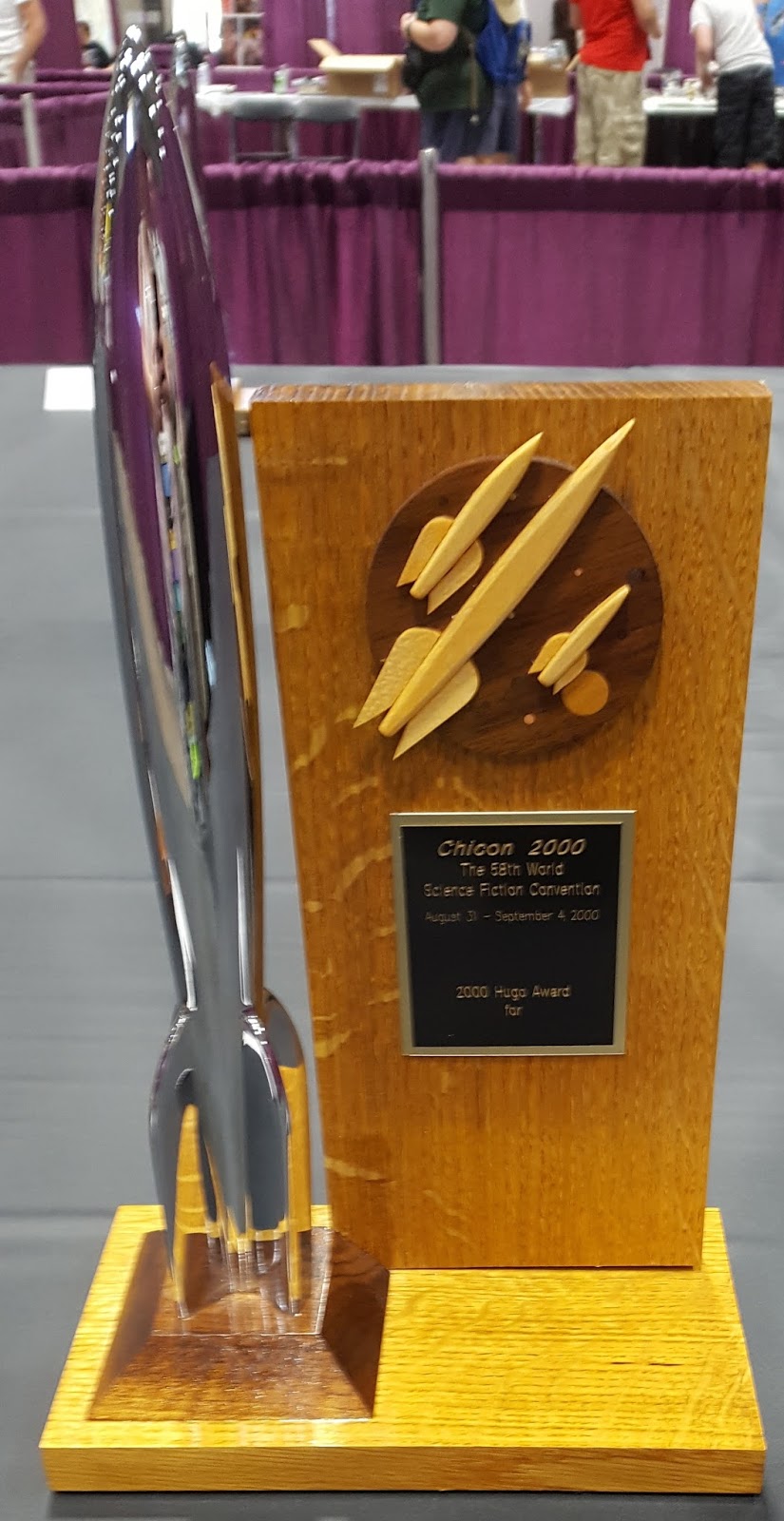
Saturday, September 2, 2000

2000 Hugo Award Finalists

Location: Chicon 2000 in Chicago, Illinois.

Comments: 2000 was a great year for science fiction. Just look at the list of nominees for Best Novel: A Deepness in the Sky, A Civil Campaign, Cryptonmicon, and Darwin's Radio would all have been clear winners in most other years. The only book that sticks out as misplaced on this list is Harry Potter and the Prisoner of Azkaban, and that's not because it is a bad book, but rather because it just isn't nearly as good as the rest of the field.

The other categories were similarly strong, most notably the Best Dramatic Presentation field, in which the hilarious Star Trek spoof Galaxy Quest beat out a field that included The Matrix and The Iron Giant. It does, however, seem somewhat ironic that at this point Star Trek parody movies have won more Hugo awards than actual Star Trek movies have.

The other noteworthy thing about the 2000 Hugo Awards is Michael Swanwick's win for his short story Scherzo with Tyrannosaur, which was his second win in and many years, and the middle of four year run in which he won the Hugo Award for Best Short Story three times.

Best Novel

Winner:
A Deepness in the Sky by Vernor Vinge

Other Finalists:
A Civil Campaign by Lois McMaster Bujold
Cryptonomicon by Neal Stephenson
Darwin's Radio by Greg Bear
Harry Potter and the Prisoner of Azkaban by J.K. Rowling

Best Novella

Winner:
The Winds of Marble Arch by Connie Willis

Other Finalists:
The Astronaut from Wyoming by Adam-Troy Castro and Jerry Oltion
Forty, Counting Down by Harry Turtledove
Hunting the Snark by Mike Resnick
Son Observe the Time by Kage Baker

Best Novelette

Winner:
1016 to 1 by James Patrick Kelly

Other Finalists:
Border Guards by Greg Egan
The Chop Girl by Ian R. MacLeod
Fossil Games by Tom Purdom (reviewed in Lovers & Fighters, Starships & Dragons)
The Secret History of the Ornithopter by Jan Lars Jensen
Stellar Harvest by Eleanor Arnason

Best Short Story

Winner:
Scherzo with Tyrannosaur by Michael Swanwick

Other Finalists:
Ancient Engines by Michael Swanwick
Hothouse Flowers by Mike Resnick
macs by Terry Bisson
Sarajevo by Nick DiChario

Best Nonfiction, Related, or Reference Work

Winner:
Science Fiction of the 20th Century by Frank M. Robinson

Other Finalists:
Minicon 34 Restaurant Guide by Karen Cooper and Bruce Schneier
The Sandman: The Dream Hunters by Neil Gaiman, illustrated by Yoshitaka Amano
The Science of Discworld by Terry Pratchett, Ian Stewart, and Jack Cohen
Spectrum 6: The Best in Contemporary Fantastic Art by Cathy Fenner and Arnie Fenner

Best Dramatic Presentation

Winner:
Galaxy Quest

Other Finalists:
Being John Malkovich
The Iron Giant
The Matrix
The Sixth Sense

Best Professional Editor

Winner:
Gardner Dozois

Other Finalists:
Patrick Nielsen Hayden
David G. Hartwell
Stanley Schmidt
Gordon van Gelder

Best Professional Artist

Winner:
Michael Whelan

Other Finalists:
Jim Burns
Bob Eggleton
Donato Giancola
Don Maitz

Best Semi-Prozine

Winner:
Locus edited by Charles N. Brown

Other Finalists:
Interzone edited by David Pringle
The New York Review of Science Fiction edited by Kathryn Cramer, Ariel Haméon, David G. Hartwell, and Kevin J. Maroney
Science Fiction Chronicle edited by Andrew I. Porter
Speculations edited by Kent Brewster

Best Fanzine

Winner:
File 770 edited by Mike Glyer

Other Finalists:
Ansible edited by Dave Langford
Challenger edited by Guy H. Lillian III
Mimosa edited by Nicki Lynch and Richard Lynch
Plokta edited by Alison Scott, Steve Davies, and Mike Scott

Best Fan Writer

Winner:
Dave Langford

Other Finalists:
Bob Devney
Mike Glyer
Evelyn C. Leeper
Steven H. Silver

Best Fan Artist

Winner:
Joe Mayhew

Other Finalists:
Freddie Baer
Brad W. Foster
Teddy Harvia
Taral Wayne

John W. Campbell Award for Best New Writer

Winner:
Cory Doctorow

Other Finalists:
Thomas Harlan
Ellen Klages
Kristine Smith
Shane Tourtellotte

What Are the Hugo Awards?

Go to previous year's finalists: 1999
Go to subsequent year's finalists: 2001

Book Award Reviews     Home

Sunday, July 2, 2000

2000 Locus Award Nominees

Location: Westercon in Honolulu, Hawaii.

Comments: There are some authors who are so prolific over such a prolonged period of time that they seem almost inhuman. As examples of this phenomenon I point to Robert Silverberg and Ursula K. Le Guin. Silverberg started his career in the 1950s, Le Guin in the 1960s. Both became dominant voices in the science fiction world in the 1970s, and have continued to turn out fantastic work to this day. In the 2000 Locus Awards ballot, Silverberg's name appears three times, while Le Guin's appears twice. Unlike many authors who turned increasingly towards exclusively writing novels in their later careers, both Silverberg and Le Guin have continued to produce works of all lengths throughout theirs. How they produce such a vast amount of brilliant fiction is a mystery to me, but I'm certainly glad that they do.

Best Science Fiction Novel
Winner:
1.   Cryptonomicon by Neal Stephenson

Other Nominees:
2.   Darwin's Radio by Greg Bear
3.   A Deepness in the Sky by Vernor Vinge
4.   A Civil Campaign by Lois McMaster Bujold
5.   Ender's Shadow by Orson Scott Card
6.   Forever Free by Joe Haldeman
7.   Precursor by C.J. Cherryh
8.   On Blue's Waters by Gene Wolfe
9.   The Naked God by Peter F. Hamilton
10. Teranesia by Greg Egan
11. The Cassini Division by Ken MacLeod
12. The Martian Race by Gregory Benford
13. Waiting by Frank M. Robinson
14. Time: Manifold 1 (aka Manifold: Time) by Stephen Baxter
15. All Tomorrow's Parties by William Gibson
16. Bios by Robert Charles Wilson
17. The Far Shore of Time by Frederik Pohl
18. Greenhouse Summer by Norman Spinrad
19. Finity by John Barnes
20. (tie) Ancients of Days by Paul J. McAuley
      (tie) Souls in the Great Machine by Sean McMullen
22. Singer from the Sea by Sheri S. Tepper
23. The Extremes by Christopher Priest
24. (tie) The Conqueror's Child by Suzy McKee Charnas
      (tie) Tower of Dreams by Jamil Nasir

Best Fantasy Novel
Winner:
1.   Harry Potter and the Prisoner of Azkaban by J.K. Rowling

Other Nominees:
2.   The Fifth Elephant by Terry Pratchett
3.   Fortress of Owls by C.J. Cherryh
4.   Dark Cities Underground by Lisa Goldstein
5.   Tamsin by Peter S. Beagle
6.   The Eternal Footman by James Morrow
7.   Enchantment by Orson Scott Card
8.   Mr. X by Peter Straub
9.   A Calculus of Angels by J. Gregory Keyes
10. The Marriage of Sticks by Jonathan Carroll
11. Dragonshadow by Barbara Hambly
12. A Red Heart of Memories by Nina Kiriki Hoffman
13. The Rainy Season by James P. Blaylock
14. Black Light by Elizabeth Hand
15. The Stars Compel by Michaela Roessner
16. The Sub by Thomas M. Disch
17. Saint Fire by Tanith Lee
18. The Wild Swans by Peg Kerr
19. Sea Dragon Heir by Storm Constantine
20. Rhapsody by Elizabeth Haydon

Best First Novel
Winner:
1.    The Silk Code by Paul Levinson

Other Nominees:
2.   The Shadow of Ararat by Thomas Harlan
3.   Starfish by Peter Watts
4.   Code of Conduct by Kristine Smith
5.   The Thief's Gamble by Juliet E. McKenna
6.   King Rat by China Miéville
7.   Shiva 3000 by Jan Lars Jensen
8.   Prospero's Children by Jan Siegel
9.   Time Future by Maxine McArthur
10. Rhapsody by Elizabeth Haydon
11. Nocturne for a Dangerous Man by Marc Matz
12. Silver Screen by Justina Robson
13. The Divinity Student by Michael Cisco
14. The Chosen by Ricardo Pinto
15. Gardens of the Moon by Steven Erikson

Best Novella
Winner:
1.   Orphans of the Helix by Dan Simmons

Other Nominees:
2.   Crocodile Rock by Lucius Shepard
3.   The Winds of Marble Arch by Connie Willis
4.   Old Music and the Slave Women by Ursula K. Le Guin
5.   The Way of All Ghosts by Greg Bear
6.   Hunting the Snark by Mike Resnick
7.   The Actors by Eleanor Arnason
8.   Argonautica by Walter Jon Williams
9.   The Executioners' Guild by Andy Duncan
10. Baby's Fire by Robert Reed
11. (tie) Forty, Counting Down by Harry Turtledove
      (tie) The Wedding Album by David Marusek
13. Son Observe the Time by Kage Baker
14. The Exile of Evening Star by Allen M. Steele
15. The Astronaut from Wyoming by Adam-Troy Castro and Jerry Oltion
16. Twenty-One, Counting Up by Harry Turtledove
17. Hatching the Phoenix by Frederik Pohl
18. Andy Warhol's Dracula by Kim Newman
19. The Gateway of Eternity by Brian Stableford
20. Leningrad Nights by Graham Joyce
21. Once Upon a Matter Crushed by Wil McCarthy

Best Novelette
Winner:
1.   (tie) Border Guards by Greg Egan
      (tie) Huddle by Stephen Baxter

Other Nominees:
3.   A Hunger for the Infinite by Gregory Benford
4.   Sleeping Dogs by Nancy Kress
5.   Mount Olympus by Ben Bova
6.   A Martian Romance by Kim Stanley Robinson
7.   (tie) The Chop Girl by Ian R. MacLeod
      (tie) Darkrose and Diamond by Ursula K. Le Guin
      (tie) A Knight of Ghosts and Shadows by Gardner Dozois
10. Vessel by Orson Scott Card
11. A Hero of the Empire by Robert Silverberg
12. Dapple: A Hwarhath Historical Romance by Eleanor Arnason
13. Stellar Harvest by Eleanor Arnason
14. How to Make Unicorn Pie by Esther M. Friesner
15. The Secret History of the Ornithopter by Jan Lars Jensen
16. Green Acres by Allen M. Steele
17. 1016 to 1 by James Patrick Kelly
18. Smart Alec by Kage Baker
19. Game of the Century by Robert Reed
20. Nodaway by Robert Reed
21. The Last Man on the Moon by Scott Edelman
22. Getting to Know the Dragon by Robert Silverberg
23. Pocketful of Dharma by Paolo Bacigalupi
24. Daddy's World by Walter Jon Williams
25. Vultures by Stephen L. Burns
26. Fossil Games by Tom Purdom (reviewed in Lovers & Fighters, Starships & Dragons)
27. The Queen of Erewhon by Lucy Sussex

Best Short Story
Winner:
1.   macs by Terry Bisson

Other Nominees:
2.   Ancient Engines by Michael Swanwick
3.   Scherzo with Tyrannosaur by Michael Swanwick
4.   Spindrift by Stephen Baxter
5.   Arthur Sternbach Brings the Curveball to Mars by Kim Stanley Robinson
6.   People Came from Earth by Stephen Baxter
7.   The Dynasters Vol. 1: On the Downs by Howard Waldrop
8.   Fish in a Barrel by Jonathan Carroll
9.   Sexual Dimorphism by Kim Stanley Robinson
10. Jennifer, Just Before Midnight by William Sanders
11. Yurek Rutz, Yurek Rutz, Yurek Rutz by David Marusek
12. (tie) Everywhere by Geoff Ryman
      (tie) Her Own Private Sitcom by Allen M. Steele
14. Human Bay by Robert Reed
15. Smoother by Terry Bisson
16. Shiva by Barry N. Malzberg
17. Ashes and Tombstones by Brian Stableford
18. (tie) An Apollo Asteroid by Brian W. Aldiss
      (tie) Into the Blue Abyss by Geoffrey A. Landis
20. Suicide Coast by M. John Harrison
21. Alien TV by Paul J. McAuley

Best Collection
Winner:
1.   The Martians by Kim Stanley Robinson

Other Nominees:
2.   A Good Old-Fashioned Future by Bruce Sterling
3.   Miracle and Other Christmas Stories by Connie Willis
4.   The Compleat Boucher by Anthony Boucher
5.   Hearts in Atlantis by Stephen King
6.   (tie) Baby is Three: Volume VI: The Complete Stories of Theodore Sturgeon by Theodore Sturgeon, edited by Paul Williams
      (tie) Rainbow Mars by Larry Niven
8.   Moonlight and Vines by Charles de Lint
9.   The Dragons of Springplace by Robert Reed
10. Apostrophes and Apocalypses by John Barnes
11. The Collected Stories of Jack Williamson, Volume One: The Metal Man and Others by Jack Williamson
12. Sex and Violence in Zero-G by Allen M. Steele
13. What Ho, Magic! by Tanya Huff
14. Reave the Just and Other Tales by Stephen R. Donaldson
15. The Robot's Twilight Companion by Tony Daniel
16. Are You Loathsome Tonight? (aka Self-Made Man) by Poppy Z. Brite
17. Really, Really, Really, Really, Weird Stories by John Shirley
18. Dragon's Fin Soup by S.P. Somtow

Best Anthology
Winner:
1.   Far Horizons edited by Robert Silverberg

Other Nominees:
2.   The Year's Best Science Fiction: Sixteenth Annual Collection edited by Gardner Dozois
3.   Year's Best SF 4 edited by David G. Hartwell
4.   The Year's Best Fantasy and Horror: Twelfth Annual Collection edited by Ellen Datlow and Terri Windling
5.   The Good New Stuff edited by Gardner Dozois
6.   Moon Shots edited by Peter Crowther and Martin H. Greenberg
7.   999: New Stories of Horror and Suspense edited by Al Sarrantonio
8.   Silver Birch, Blood Moon edited by Ellen Datlow and Terri Windling
9.   The SFWA Grand Masters: Volume One edited by Frederik Pohl
10. The Best from Fantasy & Science Fiction: The Fiftieth Anniversary Anthology edited by Edward L. Ferman and Gordon van Gelder
11. My Favorite Science Fiction Story edited by Martin H. Greenberg
12. Nebula Awards 33 edited by Connie Willis
13. Centaurus: The Best of Australian Science Fiction edited by David G. Hartwell and Damien Broderick
14. Dark Detectives: Adventures of the Supernatural Sleuths edited by Stephen Jones
15. Not of Woman Born edited by Constance Ash
16. Northern Suns edited by David G. Hartwell and Glenn Grant
17. Northern Frights 5 edited by Don Hutchison
18. The Mammoth Book of Best New Horror: Volume Ten edited by Stephen Jones

Best Nonfiction, Related, or Reference Book
Winner:
1.   Sixty Years of Arkham House by S.T. Joshi

Other Nominees:
2.   The Twinkling of an Eye or My Life as an Englishman by Brian W. Aldiss
3.   Pioneers of Wonder: Conversations with the Founders of Science Fiction by Eric Leif Davin
4.   Deconstructing the Starships: Science, Fiction and Reality by Gwyneth Jones
5.   Fantasy and Horror: A Critical and Historical Guide to Literature, Illustration, Film, TV, Radio, and the Internet by Neil Barron
6.   When Dreams Came True: Classical Fairy Tales and Their Tradition by Jack Zipes
7.   The Road to Castle Mount: The Science Fiction of Robert Silverberg by Edgar L. Chapman
8.   Strange Constellations: A History of Australian Science Fiction by Russell Blackford, Van Ikin, and Sean McMullen
9.   The Fantasy Literature of England by C.N. Manlove
10. The Robert Heinlein Interview and Other Heinleiniana by J. Neil Schulman
11. A Chesley Bonestell Space Art Chronology by Melvin H. Schuetz
12. Demand My Writing: Joanna Russ/Feminism/Science Fiction by Jeanne Cortiel

Best Art Book
Winner:
1.   Science Fiction of the 20th Century by Frank M. Robinson

Other Nominees:
2.   Spectrum 6: The Best in Contemporary Fantastic Art by Cathy Fenner and Arnie Fenner
3.   Legacy by Frank Frazetta
4.   Transluminal: The Paintings of Jim Burns by Jim Burns
5.   The Sandman: The Dream Hunters by Neil Gaiman, illustrated by Yoshitaka Amano.
6.   Maxfield Parrish, Maxfield Parrish 1870-1966 by Sylvia Yount; art by Maxfield Parrish
7.   Fantasy Art of the New Millennium (aka Fantasy Art Masters) by Dick Jude
8.   Soft as Steel: The Art of Julie Bell by Nigel Suckling; art by Julie Bell
9.   The Savage Tales of Solomon Kane by Robert E. Howard, illustrated by Gary Gianni
10. Wind Child by Shirley Rousseau Murphy, illustrated by Leo Dillon and Diane Dillon
11. The Rabbits by John Marsden and Shaun Tan

Best Editor
Winner:
1.   Gardner Dozois

Other Nominees:
2.   David G. Hartwell
3.   Gordon van Gelder
4.   Stanley Schmidt
5.   Ellen Datlow
6.   David Pringle
7.   Patrick Nielsen Hayden
8.   Robert Silverberg
9.   Scott Edelman
10. Martin H. Greenberg
11. Terri Windling
12. Shawna McCarthy

Best Magazine
Winner:
1.   Asimov's

Other Nominees:
2.   Fantasy & Science Fiction
3.   Analog
4.   Interzone
5.   Science Fiction Age
6.   Realms of Fantasy
7.   The New York Review of Science Fiction
8.   Amazing Stories
9.   Science Fiction Chronicle
10. Cemetery Dance

Best Book Publisher or Imprint
Winner:
1.   Tor

Other Nominees:
2.   Avon Eos
3.   Del Rey
4.   Bantam Spectra
5.   Baen
6.   DAW
7.   Ace
8.   HarperPrism
9.   St. Martin's
10. NESFA Press
11. Warner Aspect
12. Science Fiction Book Club
13. Gollancz/Millennium
14. Voyager
15. Golden Gryphon Press
16. Meisha Merlin
17. Roc

Best Artist
Winner:
1.   Michael Whelan

Other Nominees:
2.   Bob Eggleton
3.   Jim Burns
4.   Don Maitz
5.   Thomas Canty
6.   Frank Frazetta
7.   Donato Giancola
8.   Julie Bell
9.   Leo Dillon and Diane Dillon

Go to previous year's nominees: 1999
Go to subsequent year's nominees: 2001

Book Award Reviews     Home

Saturday, May 20, 2000

2000 Nebula Award Nominees

Location: New York, New York.

Comments: Fresh off of their experiment of reviving the Ray Bradbury Award in 1999 to honor Babylon 5, in 2000, the SFWA decided to pull the Best Script category out of mothballs and vote on a slate of nominees. The winner was M. Night Shyamalan's The Sixth Sense, and while I might have preferred the award go to The Devil's Arithmetic or The Iron Giant, who won isn't really as important as the fact that the category was voted on at all. After decades of ignoring dramatized speculative fiction and then hemming and hawing about whether to honor it, the SFWA finally decided that refusing to acknowledge the most popular form of fictional entertainment was not in the organization's best interests.

While it is nice that the SFWA begrudgingly decided to start honoring dramatic speculative fiction, one wonders why they flailed about regarding exactly how they would do this. In 1999, the SFWA bestowed the Ray Bradbury Award to honor a work of dramatic fiction. In 2000, they switched to including the Best Script on the Nebula Award ballot, which would remain on the ballot for several years before the Ray Bradbury Award was brought back. The fact that the SFWA started honoring dramatized fiction should only be surprising to the extent that it took so long for them to get around to it. But one has to wonder why they waffled so much over exactly how to do it.

Best Novel

Winner:
Parable of the Talents by Octavia E. Butler

Other Nominees:
The Cassini Division by Ken MacLeod
A Clash of Kings by George R.R. Martin
A Deepness in the Sky by Vernor Vinge
Mission Child by Maureen F. McHugh
Mockingbird by Sean Stewart

Best Novella

Winner:
Story of Your Life by Ted Chiang

Other Nominees:
The Astronaut from Wyoming by Adam-Troy Castro and Jerry Oltion
The Executioners' Guild by Andy Duncan
Living Trust by L. Timmel Duchamp
Reality Check by Michael A. Burstein
The Wedding Album by David Marusek

Best Novelette

Winner:
Mars Is No Place for Children by Mary A. Turzillo

Other Nominees:
Five Days in April by Brian A. Hopkins
Good Intentions by Stanley Schmidt and Jack McDevitt
How to Make Unicorn Pie by Esther M. Friesner
The Island in the Lake by Phyllis Eisenstein
Taklamakan by Bruce Sterling

Best Short Story

Winner:
The Cost of Doing Business by Leslie What

Other Nominees:
Ancient Engines by Michael Swanwick
Basil the Dog by Frances Sherwood
The Dead Boy at Your Window by Bruce Holland Rogers
Flower Kiss by Constance Ash
Radiant Doors by Michael Swanwick

Best Script

Winner:
The Sixth Sense by M. Night Shyamalan

Other Nominees:
The Devil's Arithmetic by Robert J. Avrech
The Iron Giant by Brad Bird and Tim McCanlies
The Matrix by Larry Wachowski and Andy Wachowski
The Uranus Experiment: Part 2 by John Millerman

Go to previous year's nominees: 1999
Go to subsequent year's nominees: 2001

Book Award Reviews     Home

Friday, December 31, 1999

1999 World Fantasy Award Nominees

Location: World Fantasy Convention, Providence, Rhode Island.

Comments: In 1999 the World Fantasy awards handed a Lifetime Achievement Award to Hugh B. Cave. This award was well-deserved, as Cave had a long and distinguished career writing fantasy fiction, but giving this award now make the decision to give Cave a Special Convention Award in 1996 all the more perplexing. Why did the judges dust off an award that hadn't been awarded in over a decade to honor Cave in 1996 if his accomplishments warranted a Lifetime Achievement Award? With about 98% of his career behind him by 1996, shouldn't Cave have qualified for a Lifetime Achievement award then? Was there some tipping point that required them to wait until 1999 when 99% of Cave's career was behind him before he was a worthy recipient?

Best Novel

Winner:
The Antelope Wife by Louise Erdrich

Other Nominees:
The Martyring by Thomas Sullivan
Mockingbird by Sean Stewart
Sailing to Sarantium by Guy Gavriel Kay
Someplace to Be Flying by Charles de Lint

Best Novella

Winner:
The Summer Isles by Ian R. MacLeod

Other Nominees:
Cold by A.S. Byatt
Dragonfly by Ursula K. Le Guin
The Hedge Knight by George R.R. Martin
Mr. Clubb and Mr. Cuff by Peter Straub

Best Short Fiction

Winner:
The Specialist's Hat by Kelly Link

Other Nominees:
The Death of the Duke by Ellen Kushner
Every Angel Is Terrifying by John Kessel
Shoggoth's Old Peculiar by Neil Gaiman
Travels with the Snow Queen by Kelly Link

Best Anthology

Winner:
Dreaming Down-Under edited by Jack Dann and Janeen Webb

Other Nominees:
The Best of Crank! edited by Bryan Cholfin
Dark Terrors 4 edited by Stephen Jones and David Sutton
Legends edited by Robert Silverberg
Starlight 2 edited by Patrick Nielsen Hayden

Best Collection

Winner:
Black Glass by Karen Joy Fowler

Other Nominees:
The Cleft and Other Odd Tales by Gahan Wilson
Last Summer at Mars Hill by Elizabeth Hand
Manitou Man: The Worlds of Graham Masterton by Graham Masterton, with Ray Clark and Matt Williams
The Night We Buried Road Dog by Jack Cady

Lifetime Achievement

Winner:
Hugh B. Cave

Other Nominees:
None

Best Artist

Winner:
Charles Vess

Other Nominees:
Jim Burns
Tom Canty
Alan M. Clark
Bob Eggleton

Special Award, Professional

Winner:
Jim Turner

Other Nominees:
Les Daniels
Jo Fletcher
David Pringle
Robert Silverberg and Grania Davis

Special Award, Non-Professional

Winner:
Richard T. Chizmar

Other Nominees:
David Marshall
Steve Pasechnick
Jacob Weisman

Go to previous year's nominees: 1998
Go to subsequent year's nominees: 2000

Book Award Reviews     Home

1999 Mythopoeic Award Nominees

Location: Unknown.

Comments: When an award has a category for adult fiction and another for young adult or children's fiction, there is a recurring question of exactly where do the borders between these two categories lie. In 1999, Stardust by Neil Gaiman and Charles Vess won in the Best Adult Literature category. To a certain extent I can see why the Mythopoeic Society saw fit to classify Stardust as a work of adult fiction, but if someone had asked me whether the book was a work of adult fiction or a piece aimed at younger readers before I had seen this list, I would have replied that it was a young adult book without any hesitation. This, to me, simply reinforces the fact that the borders between categories of fiction are blurry, indistinct, and mostly idiosyncratic preferences of the observer.

Best Adult Fantasy Literature

Winner:
Stardust by Neil Gaiman and Charles Vess

Other Nominees:
The High House by James Stoddard
The History of Our World Beyond the Wave by R.E. Klein
Someplace to Be Flying by Charles de Lint
Song for the Basilisk by Patricia A. McKillip

Best Children's Fantasy Literature

Winner:
Dark Lord of Derkholm by Diana Wynne Jones

Other Nominees:
Ella Enchanted by Gail Carson Levine
Harry Potter and the Philosopher's Stone (aka Harry Potter and the Sorcerer's Stone) by J.K. Rowling
Heavenward Path by Kara Dalkey
The Squire's Tale by Gerald Morris

Scholarship Award in Inklings Studies

Winner:
C.S. Lewis: A Companion and Guide by Walter Hooper

Other Nominees:
C.S. Lewis: Writer, Dreamer & Mentor by Lionel Adey
Christian Mythmakers by Rolland Hein
Roverandom by J.R.R. Tolkien, edited by Wayne G. Hammond and Christina Scull

Myth and Fantasy Studies

Winner:
A Century of Welsh Myth in Children's Literature by Donna R. White

Other Nominees:
Dreams and Wishes: Essays on Writing for Children by Susan Cooper
No Go the Bogeyman: Scaring, Lulling, and Making Mock by Marina Warner
Oz and Beyond: The Fantasy World of L. Frank Baum by Michael O. Riley

Go to previous year's nominees: 1998
Go to subsequent year's nominees: 2000

Book Award Reviews     Home

1999 Clarke Award Nominees

Location: United Kingdom.

Comments: What can I say about the 1999 Clarke award ballot? A good work by a woman won the award, but that's not particularly noteworthy. There was a little gender imbalance in the list of nominees, but given the overall track record of the Clarke awards, that's not particularly upsetting. There is a distinct lack of minority writers on the ballot, but that's more or less par for the course for genre awards, and in any event, the Clarke Awards seem to have done a better job at being inclusive than most other awards, so I'll forgive them for this. No one seems to have been particularly shafted by these results - there was no one book that you look at and scratch your head wondering, "How did Dreaming in Smoke beat that book?", so there's no real controversy to be had there. other than remarking on how well-run the Clarke Awards seem to be, there is basically nothing to say about them here.

Winner
Dreaming in Smoke by Tricia Sullivan

Shortlist
The Cassini Division by Ken MacLeod
Cavalcade by Alison Sinclair
Earth Made of Glass by John Barnes
The Extremes by Christopher Priest
Time on My Hands: A Novel with Photographs by Peter Delacorte

What Are the Arthur C. Clarke Awards?

Go to previous year's nominees: 1998
Go to subsequent year's nominees: 2000

Book Award Reviews     Home

1999 Campbell Award Nominees

Location: Campbell Conference Awards Banquet at the University of Kansas in Lawrence, Kansas.

Comments: The most interesting thing about the 1999 Campbell Award results is not the winner, although George Zebrowski's dytopian future involving asteroid penal colonies is an excellent book. No, the most interesting thing is the nomination for Poul Anderson's book Starfarers in the twilight of the author's career. It is fairly common for an older author to receive a nomination (or even an award) late in their career for a book that is clearly not their best material more or less as a way to recognize them for their earlier, better work. But in Anderson's case, this nomination was clearly not of this sort, as Starfarers is clearly one of Anderson's better pieces of fiction, easily as good as, for example, Boat of a Million Years. Even this late in his life, Anderson was still churning out excellent fiction.

Best Novel

Winner:
Brute Orbits by George Zebrowski

Second Place:
Starfarers by Poul Anderson

Third Place:
Distraction by Bruce Sterling

Go to previous year's nominees: 1998
Go to subsequent year's nominees: 2000

Book Award Reviews     Home

1999 Prometheus Award Nominees

Location: Unknown.

Comments: In 1999, once again, the sparseness of the field of libertarian science fiction seems to have once more been on display. There's nothing in particular wrong with John Varley's The Golden Globe, and a lot that is very right about it. But what is unclear is exactly how the story of an unemployed actor going on a tour of the solar system so he can return to the Earth's moon in order to clear himself of the charge that he murdered his own father reflects libertarian values. Sure, he hitches a ride in a cargo container, plays baseball with Amish farmers on the Moon, and tangles with the Charonese Mafia, but none of the story seems to really be much more than tangentially "libertarian" in nature. The implication is that the ranks of libertarian science fiction works are so thin that one can either recognize a weak book with strong libertarian themes, or a good book that only tangentially addresses the ideology, and that seems to be a problem for an award dedicated to honoring works of libertarian science fiction.

Best Novel

Winner:
The Golden Globe by John Varley

Other Nominees:
Masque by F. Paul Wilson and Matthew Costello
Moonwar by Ben Bova
Rogue Star by Michael F. Flynn
Y2K: The Millennium Bug by Don L. Tiggre

Hall of Fame

Winner:
A Planet for Texans (aka Lonestar Planet) by H. Beam Piper and John J. McGuire

Other Nominees:
Circus World by Barry B. Longyear
A Clockwork Orange by Anthony Burgess
The Emperor's New Clothes by Hans Christian Andersen
Orion Shall Rise by Poul Anderson

Go to previous year's nominees: 1998
Go to subsequent year's nominees: 2000

Book Award Reviews     Home

Saturday, September 4, 1999

1999 Hugo Award Finalists

Location: AussieCon Three in Melbourne, Australia.

Comments: Looking at the 1999 Hugo award winners alongside the other nominees they were competing against, I can only incredulously think "The Truman Show? How in the world did that overly long, pretentious, bore fest that consisted of almost nothing but Jim Carey mugging for the camera win a Hugo?" And then one looks at the competition and the mystery becomes even deeper. It should come as no surprise that in my opinion the Babylon 5 episode Sleeping in the Light should have won, but how did The Truman Show beat out Pleasantville and Dark City as well? It is just inexplicable unless one assumes that Peter Weir had pictures of the entire Hugo voting pool in compromising positions with farm animals.

And the reason for this conclusion is that with respect to the rest of the award categories, the voters seem to have done a creditable job of selecting worthwhile winners. If the other categories had had as inexplicably silly winners as the Best Dramatic Presentation category, then one could chalk The Truman Show's win up to the voters simply having lost their minds in a kind of mob mental lapse. But Connie Willis' To Say Nothing of the Dog is a fine novel, and a deserving Hugo winner, as are the winners in all the other categories, so the mystery remains.

Best Novel

Winner:
To Say Nothing of the Dog by Connie Willis

Other Finalists:
Children of God by Mary Doria Russell
Darwinia by Robert Charles Wilson
Distraction by Bruce Sterling
Factoring Humanity by Robert J. Sawyer

Best Novella

Winner:
Oceanic by Greg Egan

Other Finalists:
Aurora in Four Voices by Catherine Asaro
Get Me to the Church on Time by Terry Bisson
Story of Your Life by Ted Chiang
The Summer Isles by Ian R. MacLeod

Best Novelette

Winner:
Taklamakan by Bruce Sterling

Other Finalists:
Divided by Infinity by Robert Charles Wilson
Echea by Kristine Kathryn Rusch
The Planck Dive by Greg Egan
Steamship Soldier on the Information Front by Nancy Kress
Time Gypsy by Ellen Klages
Zwarte Piet's Tale by Allen M. Steele

Best Short Story

Winner:
The Very Pulse of the Machine by Michael Swanwick

Other Finalists:
Cosmic Corkscrew by Michael A. Burstein
Maneki Neko by Bruce Sterling
Radiant Doors by Michael Swanwick
Whiptail by Robert Reed
Wild Minds by Michael Swanwick

Best Nonfiction, Related, or Reference Work

Winner:
The Dreams Our Stuff Is Made Of: How Science Fiction Conquered the World by Thomas M. Disch

Other Finalists:
The Hugo, Nebula, and World Fantasy Awards by Howard DeVore
Science-Fiction: The Gernsback Years by Everett F. Bleiler
Spectrum 5: The Best in Contemporary Fantastic Art edited by Cathy Fenner and Arnie Fenner
The Work of Jack Williamson: An Annotated Bibliography and Guide by Richard A. Hauptmann

Best Dramatic Presentation

Winner:
The Truman Show

Other Finalists:
Babylon 5: Sleeping in Light
Dark City
Pleasantville
Star Trek: Insurrection

Best Professional Editor

Winner:
Gardner Dozois

Other Finalists:
Scott Edelman
David G. Hartwell
Patrick Nielsen Hayden
Stanley Schmidt
Gordon van Gelder

Best Professional Artist

Winner:
Bob Eggleton

Other Finalists:
Jim Burns
Donato Giancola
Don Maitz
Nick Stathopoulos
Michael Whelan

Best Semi-Prozine

Winner:
Locus edited by Charles N. Brown

Other Finalists:
Interzone edited by David Pringle
The New York Review of Science Fiction edited by Kathryn Cramer, Ariel Haméon, David G. Hartwell, and Kevin J. Maroney
Science Fiction Chronicle edited by Andrew I. Porter
Speculations edited by Denise Lee

Best Fanzine

Winner:
Ansible edited by Dave Langford

Other Finalists:
File 770 edited by Mike Glyer
Mimosa edited by Richard Lynch and Nicki Lynch
Plokta edited by Alison Scott and Steve Davies
Tangent edited by David Truesdale
Thyme edited by Alan Stewart

Best Fan Writer

Winner:
Dave Langford

Other Finalists:
Bob Devney
Mike Glyer
Evelyn C. Leeper
Maureen Kincaid Speller

Best Fan Artist

Winner:
Ian Gunn

Other Finalists:
Freddie Baer
Brad W. Foster
Teddy Harvia
Joe Mayhew
D. West

John W. Campbell Award for Best New Writer

Winner:
Nalo Hopkinson

Other Finalists:
Kage Baker
Julie E. Czerneda
Susan R. Matthews
James Van Pelt

What Are the Hugo Awards?

Go to previous year's finalists: 1998
Go to subsequent year's finalists: 2000

Book Award Reviews     Home