Showing posts with label Mythology. Show all posts

Thursday, September 13, 2018

Review - Stories from the Iliad and Odyssey by G. Chandon


Short review: A prose translation of Homer's two epic poems the Iliad and the Odyssey.

Haiku
Translated to French
Then translated to English
With some Roman gods

Full review: Stories from the Iliad and Odyssey is an English prose translation of a French prose interpretation of the two famous ancient Greek poems by Homer. While the original poems were decidedly adult in nature, the versions presented in this book are aimed at younger readers, presumably to serve as an introduction of sorts to the classic works. Both poems have had chunks cut out of the narrative in this translation, although the basic stories remain unchanged. Several full-color plates depicting events from the stories are interspersed through the book.

The Iliad section comes first. It is, of course, the story of a brief period near the end of the ten year siege of Troy by the Greeks, culminating with the showdown between the Trojan hero Hector and the Greek hero Achilles. Due to the frequent interference of the Gods in the war, one of the oddities of this translation becomes quickly apparent: while the names of the heroes are all Greek, the various deities are referred to using their Romanized names. Consequently, the book refers to Achilles, Agamemnon, and Ajax on the one hand, and Jupiter, Mars, and Venus on the other. For some readers this may not be as jarring as it was to me, but every time I read about Minerva showing her concern for Patrocles, it just seemed to so odd to me that it pulled me out of the story a bit. Some of the better bits of Homeric imagery are left out of this version: for example the description of the various contingents of the Greek and Trojan armies is omitted, as well as the scene following Patrocles' death in which Achilles is made into a glowing tower of light by Athena to frighten the Trojans. In short, just about anything that is not directly related to the main storyline is left out, which reduces the poem to a fairly simple narrative. Simplifying the narrative probably makes the book more accessible to younger readers, but it does have the unfortunate side effect of eliminating a fair amount of interesting elements from the story.

The Odyssey follows the Iliad in the book, and like the first section, this portion is dramatically simplified. The basic structure of Ulysses' voyage is kept intact - his encounter with the cyclops Polyphemus, his visit with Aeolas, his struggles with the enchantress Circe and a couple of his seafaring travails - including Scylla, Charybdis, and the Sirens. However, many of Ulysses' adventures are simply removed from the story - he and his men do not run afoul of Helios by eating his sacred cattle, he never journeys to the land of the dead, and so on. Some of the scenes were probably excised from both poems because they didn't show the heroes in a light that would be appealing to the sensibilities of 20th century readers - the scene in which the twelve servant girls in Ithaca who slept with the unruly suitors are hanged is removed, as are a couple of instances in both stories in which the heroes behave in what would best be described as a piratical or particularly bloodthirsty manner (although those scenes that are necessary for the story in which the heroes do this have been left in). While I understand the need to truncate the tale to make it palatable to the intended younger audience, I think that this shortening process is unfortunate as Ulysses' resulting journey seems far too short and much too straightforward.

Despite both poems being shortened in this translation, this remains a decent introduction to Homer for a young reader. One note that must be made is that the language is somewhat stilted. This is probably a byproduct of the fact that it is the translation of a translation, and it was written in a time period in which formal and stylized language was expected. Even so, there isn't anything in this version that should be too difficult for a pre-adolescent reader to grasp, understand, and enjoy. While someone who has already been exposed to a more complete version of these poems, this may seem annoyingly incomplete, but for a reader for whom this is their first encounter with Homer, this version, being in prose, is probably a good place to start.

G. Chandon     Book Reviews A-Z     Home

Tuesday, February 12, 2013

Biased Opinion - Lena Dunham and Aphrodite

Lena Dunham
In the picture to the left is Lena Dunham, the creator, writer, and star of the HBO series Girls. She plays a twenty-something barista living in New York and trying to negotiate her way through the hazards of being single and looking for love and sex. The show is something like Sex and the City, if Sex and the City had actual characters rather than talking manikins. And the fact that she does not look like the stereotypical television leading lady has led to all sorts of idiotic criticism. In fact, she was criticized for the picture here, because she dared to show her supposedly unsexy thighs.

In the series, Dunham's character has the temerity to actually engage in sex scenes. And she has the audacity to be attractive to men without fitting the cookie cutter version of "sexy" that Hollywood pumps out. And this, apparently, has scandalized the media. Because, at least according to the prevailing wisdom of the media, women who look like Lena are supposed to be desperately hungry for sex anywhere they can get it, and when they do, they are supposed to be properly thankful that a man has deigned to find them attractive enough to sleep with them.

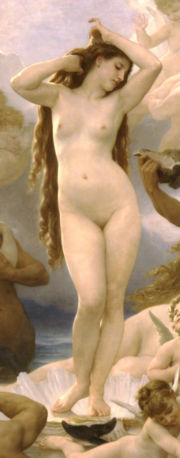
Aphrodite, complete with
large thighs and a small bust.
And what has gotten a lot of people's panties in a twist the past few days is that in the most recent episode of Girls Dunham's character Hannah had a tryst with a divorced doctor played by Patrick Wilson. Because Wilson is, it seems, a handsome man. And the shrieks of incredulity from some sectors that a man who looks like Wilson would never be sexually interested in a woman who looks like Dunham have been both hysterical and deafening. Let's leave aside the fact that criticisms coming from people like Linda Stasi that Dunham has "giant thighs", a "sloppy backside", and a "blobby body" are clearly completely off-base and demonstrably false. Let's also leave aside the fact that it is common in Hollywood to have a sloppy, fat, and not very attractive man paired with a beautiful woman - for example Jim Belushi and Courtney Thorne Smith in According to Jim, or Mark Addy and Jami Gertz in Still Standing - the simple fact is that these criticisms are stupid. And not only that, they exhibit a level of ignorance about history that is, to put it bluntly, almost shocking.

Aphrodite,
whose "giant thighs"
and "sloppy backside"
make her clearly
undesirable
Brian Moylan, a seemingly uneducated lout who writes for Hollywood.com, found Dunham's pairing with Wilson completely unbelievable, writing "[l]ast night when Lena Dunham – the writer, director, star, and all-around powerhouse behind HBO's buzzy show Girls – leaned in and kissed the dreamy Patrick Wilson and he kissed her back, the snarkier parts of the audience (myself included) immediately thought, "Oh please, there is no way that he would get with her!" The rest of the episode, in which Dunham's Hannah spends two days in the loving arms of Wilson's Joshua, was a suspension of disbelief, as we're supposed to imagine that this romantic coupling is accepted by today's society. Their discrepancy was only made more apparent in a scene where Hannah and Joshua play half-naked ping pong and Wilson looks like a bronzed statue of Hercules and Dunham looks, well, not quite like an Aphrodite." [emphasis added]. But even a few minutes of reflection by someone who has at least some modicum of an education will realize that Dunham looks exactly like an Aphrodite. She just doesn't look like the very narrow vision of attractiveness that Hollywood permits. Popular culture, led by the artificial and culturally illiterate band of television and movie executives that turn out popular entertainment, has defined "beauty" down to something so narrow that it is almost wholly at odds with anything that anyone prior to the rise of porn as the medium that defines what women should look like.

Another woman
with a "blobby body"
And it wasn't just that the ancient Greeks thought that women with strong thighs, ample hips, and a modest bust were attractive. Down through history, women who look like Dunham would have been thought as beautiful. Even as recently as the 1950s and 1960s a woman built like Dunham would have been considered attractive, or even, a sex symbol. And woman like Jean Harlow, Jayne Mansfield, and even Marilyn Monroe would be lambasted as fat cows by today's media. Even a woman as beautiful as Christina Hendricks has people talking about how she's beautiful "for a bigger girl". When the plain fact is that she's beautiful, period. And so is Lena Dunham. For centuries, we considered women who look like actual women beautiful. And now we talk about how fat an unattractive they are, to the point where Dunham's on camera sex scenes have been compared to "rape", and a semi-literate moron like Moylan can claim that Dunham looks "not quite like Aphrodite".

And to all that I say: Moylan, you should be ashamed. You should go hide your face for pretending to be a writer while displaying a level of ignorance about Greek mythology that would embarrass a sixth grader. And fuck you for not recognizing beauty when you see it.

Biased Opinions     Home