 |
| Babylon 5's command crew as never seen again. |
Short review: Welcome to Babylon 5. Now let's frame Sinclair.
Haiku
With
The Gathering
Although not yet fully formed
Babylon 5 starts
Full review: I am always torn when I introduce someone new to
Babylon 5 - do I tell them to start with
The Gathering, or just have them skip it and go straight to
Midnight on the Firing Line? This is because
The Gathering is so different in tone and appearance from the rest of the series (in large part because it aired nearly a year before the series itself got off the ground), and in a lot of ways, is just not a particularly effective introduction to the show. Oddly, for a program intended as a pilot for a television series, it probably is much more entertaining for someone who has already seen at least a chunk of episodes of the actual show, rather than someone who is a complete newcomer. For a veteran watcher of the series, the show is laden with ironic twists, quirky oddities that never show up again, and the embryos that will develop into major plot points. For the newcomer, the movie is probably going to seem somewhat slow, and fairly confusing. Even so, I have always ended up starting off a neophyte with
The Gathering, because when I get to Londo Mollari's opening voice over, the series just pulls me in.
I was there at the dawn of the Third Age of Mankind. It began in the Earth year 2257, with the founding of the last of the Babylon stations, located deep in neutral space. It was a port of call for refugees, smugglers, businessmen, diplomats and travelers from a hundred worlds. It could be a dangerous place, but we accepted the risk because Babylon 5 was our last, best hope for peace. Babylon 5 was a dream given form, a dream of a galaxy without war where species from different worlds could live side by side in mutual respect. Babylon 5 was the last of the Babylon stations. This is its story. - Londo Mollari
And with that, the series begins. One interesting thing about this voice-over is that it is told in the past tense: by the time the speaker is talking,
Babylon 5's story has presumably ended, and long enough ago that Londo needs to make a point of pointing out that he was there for the events. In other words, Londo knows how the story ends, even if the audience does not. I'll digress for a bit here and point out that there are two distinct versions of
The Gathering in circulation. When the show was originally aired in 1993, as a pilot for the series on PTEN, it was fairly long and slow. This version is only available online, on sites like Hulu. After the fourth season of the show, PTEN abandoned the series and it moved to TNT. As part of the shift to the new network, J. Michael Straczynski recut a "special" version of
The Gathering to make the plot move faster, which as a side effect allowed him to add in some additional character development scenes. In addition, the special edition excised an extended walk through the alien sector, which, quite frankly, was kind of dull and not really necessary to the plot of the episode, or the eventual overarching plots of the series itself. The "special edition" is the one that is included on both versions offered on DVD: the two-sided DVD with
The Gathering and In the Beginning, and the
Babylon 5: The Movie Collection DVD set. For clarity, the version I am going to talk about here is the "special edition".
 |
| Commander Jeffrey Sinclair |
At the outset I'll note that even though the special edition is quicker paced and flows better than the original television pilot did, the show unfolds fairly slowly. This is mostly because the show has to do some fairly heavy expositional lifting: introducing four alien races, the political web that interlocks them together, a half dozen major characters, and of course, something of a story to tie everything together. There are no dramatic space battles, and very few action sequences. The basic plot of the movie - a murder mystery interlaced with diplomatic posturing - sets the tenor of the show itself, which was heavy on political intrigue and character development. However, despite being recognizably related,
The Gathering is quite different from the series that came after - both in appearance and tone. In the end, most of the changes were ultimately beneficial, as it seems that during the eleven month lag several elements of the show were reexamined and improved substantially. Only a few (such as the switch from Patricia Tallman to Andrea Thompson as the installation's primary commercial telepath) were net losses for the show.
 |
| My name is Laurel Takashima. You won't see me again. |
To a certain extent, given the eleven month lag between the airing of the pilot and the first episode, it is somewhat amazing that they managed to keep as much of the cast from the movie for the series - Michael O'Hare (as Commander Jeffrey Sinclair), Jerry Doyle (as Michael Garibaldi), Mira Furlan (as Delenn), Peter Jurasik (as Londo Mollari), and Andreas Katsulas (as G'Kar) all transition from the pilot to the series. But Tamlyn Tomita (as Lieutenant Commander Laurel Takashima), Johnny Sekka (as Dr. Benjamin Kyle), Blair Baron (as Carolyn Sykes), and, as noted before, Patricia Tallman (as Lyta Alexander)left the series, and all but Tallman were never seen again on the series. In a shift that is horribly disconcerting to me, Ed Wasser also made the transition from the pilot to the series, but shifted characters from the command deck crew member seen here to, well, a pretty different role in the series proper.
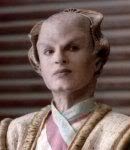 |
Hi. I'm Delenn.
I'll look very different soon.
Twice. |
In addition to the cast changes, the appearance of the show changed substantially as well - most notably in the appearance of the Minbari. In
The Gathering, the Minbari appear much more androgynous than they do on the series. I suspect that Straczynski was trying to create a race somewhat akin to the genderless and gender-switching Geth from Ursula K. LeGuin's
The Left Hand of Darkness, but that is purely speculation on my part. No matter if this is true or not, this experiment doesn't survive past this movie, and the appearance of the Minbari is pretty substantially revised for the remainder of the series. Both G'Kar and Londo have some alterations to their appearance as well. But the most notable change in appearance is that of the station itself. Throughout
The Gathering, the station is fairly dark. Much of the episode takes place in shadow or in very subdued lighting, which for me tires my eyes out when I watch it. I'll also note that the decision to film the episode with this kind of lighting does not do any favors to Johnny Sekka, whose very dark complexion combines with the darkened lighting to effective obscure his facial features in several scenes. During the run of the series, the station became a much better lit place, except for scenes that take place "down below" (which actually served to contrast the portions of the station better).
So, the show open on the shadowy command deck, which I guess is supposed to be atmospheric, but why would the command deck be poorly lit? After a brief interlude where Sinclair warns a tourist off of a sexual encounter with a dangerous alien, we move to the entry corridor (a set that ended up being completely redesigned for the series) where Sinclair meets with the new commercial telepath Lyta Alexander. After Garibaldi completely screws up the apprehension of a drug smuggler attempting to board the station, Sinclair gets the chance to play the tough negotiator. This scene is quite strangely laid out - first off, with his entire security team there, presumably including trained hostage negotiators, why would Sinclair jump in? And why does Garibaldi need Sinclair need him to tell him what to do in a situation like this? Garibaldi is head of security, he should not only pretty much know what to do in this situation but his team should have a standard procedure for dealing with it. I know this is a pretty standard type of scene to establish the character of the leading man, but like many other scenes in this episode, it mostly just serves to diminish Garibaldi as a character who is effective in his job (making one wonder exactly why Sinclair keeps expressing so much confidence in him). In the end, Sinclair makes an angry speech about how "no weapons or dust" are allowed on the station (and dust will return as an issue most notably in the season three episode
Dust to Dust), he goes back to a modestly distraught Lyta, puts on a big incongruously happy smile and says "I'll get you to your quarters".
I'll also note that this scene is just the first of the strange relationship Babylon 5 has with distance. Sinclair tells the smuggler that if his ship ever gets "within fifty clicks" of Babylon 5, they will blow him out of the sky. Now, unless they meant to coin a new vernacular here, clicks is usually a slang term for kilometers. Fifty kilometers is not a particularly long distance for weapon systems on Earth in the present day. In space, fifty clicks is so close that it would be practically inside the station. This scene also shows a very different style of personal weaponry used - both Garibaldi and the smuggler have a very obviously plastic hand weapon that looks like a rejected phaser design. This is another design quirk that doesn't last beyond the pilot episode.
 |
| Hey! Aren't you supposed to be on the rim somewhere? |
We move back to the shadowy command deck and are introduced to Laurel Takashima, the no nonsense Lieutenant Commander who is preparing for the arrival of the ambassador from the secretive Vorlon race, but takes time to confront Ambassador G'Kar over the refusal of a Narn supply ship to submit to a weapons scan, telling him that they can wait outside for a "solar year" for all she cares. This is a sort of forced toughness that just doesn't seem to suit Tamlyn, which I suspect is one of the reasons she was replaced by Claudia Christian as the second in command of the station. The early command deck scenes are also where we first get a shot of Ed Wasser on the command deck, which is, of course, quite a dissonant moment. This sort of continuity gaffe is, I think, one of the reasons doing television is more difficult today than it may have been in the past. Now that television shows are available on DVD, tiny errors that would have been overlooked and forgotten are now noticeable. (And really, without watching
The Gathering on DVD after seeing the whole series, who would have remembered that Ed Wasser was on the command deck in a couple scenes of the pilot episode?) And of course, with the internet, these sorts of tiny details can be dissected in detail. One of the most impressive things about
Babylon 5 is that there are so few of these sorts of errors, and most of them are, ultimately, fairly trivial.
Hopping back to Sinclair and Lyta, they cut through the alien sector. In the original version of The Gathering, this led to a lengthy tour laden with special effects intended to both show off how large the station is, and to provide a glimpse of the wide array of aliens that populate the
Babylon 5 universe. This has mostly been excised from the special edition, which is good from a narrative standpoint - the extended tour really broke up the story - but comes at something of a cost. Either way, much of Sinclair's mostly-monologue to Lyta (in this scene and the last) is basically a spoken version of the "As you know Bob" scenes that plague science fiction in which a character tells another character things they really should already know for the narrative purpose of telling the reader (or in this case the viewer). Sinclair reviews the rules for telepaths on the station, something someone would think Lyta would know already, being a member of Psi Corps. Lyta even asks Sinclair why it is called Babylon 5, whereupon he explains that the first three stations were sabotaged and the fourth vanished without a trace. But one has to wonder why she wouldn't know that already. The destruction of an installation intended to be the headquarters for interstellar equivalent of the U.N. should have been big news, and someone coming to reside there probably would know this already. But since the viewer needs to be handed this information, Sinclair tells Lyta things she should already know.
 |
| A pool for zen skinny-dipping |
After going over the fact that they know next to nothing about Vorlons with his command staff, Sinclair meets with Delenn. One element of
The Gathering that was not really carried forward to the series is an Asian influence - the loss of Tamlyn Tomita as a character removes her Asian-themed quarters, and also missing from the series for the most part is the Japanese stone garden that serves as the setting for the first interaction between Delenn and Commander Sinclair. As is usual for a Straczynski scene, the setting serves as the third character as Delenn interprets the meaning of the garden as she sees it, and then demonstrates an unusual affinity for Sinclair by handing over all the data she has concerning the Vorlons (using a data card, another difference from the series, where data crystals are used). This is also where we get the first hints concerning the Earth-Minbari war. In a kind of odd statement, Delenn mentions that she is looking forward to meeting a Vorlon. For those familiar with the show, this is an interesting comment - either this is a continuity error or Delenn is playing her cards quite close to the chest.
 |
| I'm the Commander's girlfriend. At least for now. |
The pace quickens a bit, as Kosh shows up early, giving us the first view in the series of a hyperspace jump gate, and the first view of a Vorlon living ship (the Vorlon living technology predates the appearance of the living ship Moya on
Farscape by about five years too). We also see brief, mysterious and apparently deadly transaction, and Sinclair's girlfriend announcing her impending early arrival at the station (everyone seems to be showing up early). Pretty soon, the tropes that will become recurring elements of the show start flowing thick and fast though. In a scene between Takashima and G'Kar in which G'Kar says his ship has reconsidered an will now allow a weapons scan, he uses the Narn salutation "Good Eating" for the first time. In the background of the scene we also get a shot of a worker doing some sort of repair work in a steam vent - an indication that the show intends to present an industrial kind of science fiction, with shots of the blue collar work that goes in to making an installation like Babylon 5 function (most notably followed up on in episodes like
By Any Means Necessary and
A View from the Gallery). The action shifts to the casino where Garibaldi is hunting down Londo to ensure he is there to meet the Vorlon Ambassador Kosh when he arrives. This is the first opportunity for Londo to give a story about the good old days of the Centauri Republic. One thing that is odd about this scene is that Garibaldi is sent to ensure that the Centauri Ambassador is present for the reception. One would think that whether Londo showed up for the reception would be a matter for the Centauri government to police, not for the Babylon 5 security chief to deal with. If the Centauri want to make a diplomatic gaffe and have their representative snub the Vorlons, isn't that up to them? As a side note, this is the first scene where we see Londo's truly impressive hair, which was thankfully toned down for the series itself.
We move back to a little character development as we see Lyta plying her trade, acting as an intermediary between two businessmen negotiating a deal. This scene is noteworthy for the appearance of "Universe Today" in a brief scanning shot, and G'Kar's attempt to negotiate a deal with Lyta for her genetic material to try to develop telepaths for the nontelepathic Narn race. Besides finding out that the Narn lack telepaths, we also learn, for the first time, of G'Kar's proclivity for non-Narn women. And we learn of G'Kar's high opinion of himself, as he asks Lyta if she would prefer to be conscious or unconscious for mating "depending on her pleasure threshold".
After all of this build up, the plot itself finally really gets underway. After Sinclair is stuck in a stalled transport tube he arrives to join Garibaldi and Takashima where they find an apparently nearly dead Kosh. This whole scene is odd. First off, the alarm goes off with a "station alert" letting them know something is wrong. But since Kosh is in the docking bay lying on the floor incapacitated with no one else present, who set off the alarm? Second, upon hearing the alert, Sinclair immediately turns to Takashima and says "notify station security". Leaving aside the question "notify them of what", since they haven't gone in to find Kosh lying on the floor yet, Garibaldi is
right there. His presence means that security already knows there is a problem of some sort, and since Garibaldi is the station security chief, shouldn't he be notifying his people? In one of the few sane things anyone says about Kosh's condition, Garibaldi says he cannot tell anything about the Vorlon's condition. Which, since humans know next to nothing about Vorlons one would think would be true even if Kosh wasn't wearing an encounter suit. Sinclair, on the other hand, says "if you open the suit, our air will kill him". How the hell would he know that? This is just the first in a massive string of statements by Babylon 5 characters about Kosh and his condition that make no sense at all. They are all more or less necessary statements for the story to work, but when you stop and think about them, they are just nonsensical.
 |
| Vorlons. They glow. |
Moving to Dr. Kyle's medlab, we find out that the Vorlons refuse to let Kosh's encounter suit be opened "for security reasons", but Sinclair orders Kyle to do it anyway, relying on Kyle's vow of confidentiality to preserve secrets. Takashima recounts a legend about a human seeing a Vorlon and turning to stone, while Kyle opens the suit and light streams out - the first indication in the ongoing mystery that is "what do Vorlons look like". And then it is time for more character background, as during a conversation with an unnamed Senator we learn of Garibaldi's checkered past (unknowingly expressing his reservations with Garibaldi in earshot). After Sinclair stops off to have sex with his girlfriend and take a nap, Dr. Kyle reports that they have confirmed a "foreign compound, type unknown" and that Kosh's prognosis is terminal. He tells Sinclair that "it looks like poison". Once again, how the hell would he know any of this? How would they know that any compound in Kosh's body is a "foreign compound"? How would they know he is dying? They don't know anything about his biology. As Kyle says, "even for an alien, this one is pretty alien". How could Dr. Kyle know what is or is not a poison to Kosh? For that matter, how would Dr. Kyle have known how to stabilize Kosh to begin with? Without this sequence, there is no story, but this just doesn't make any sense at all. This is one of the few seriously silly elements in this
Babylon 5 story, and one of the few stories in the series that has such a silly element: Most of the episodes are much better thought out.
Then we shift to some alien intrigue, as G'Kar tries to convince Delenn that Londo was somehow responsible for the attempt to kill Kosh and proposes an alliance. Delenn rejects it out of hand, and in the process reveals another story element that will drive much of the series - the fact that the Narn had been occupied and subjugated by the Centauri for a century. In turn, G'Kar reveals to the viewer that in the Earth-Minbari War, the Minbari had defeated Earth and then mysteriously surrendered on the eve of victory, the result of a decision that supposedly came from the Minbari holy men on the Grey Council. Delenn then whips out a weapon that is never seen again - a ring that allows her to control the local gravity around G'Kar and crush him. She uses it to force him to swear he will never mention the Grey Council again, presenting the viewer with another mystery. I suspect the ring weapon was never used again in the series because it was just not very visually interesting in action, mostly just resulting in Andreas Katsulas moaning and flailing his arms about.
 |
| My name is Londo, and I have really big hair. |
Sometimes I wonder why
Babylon 5 is such a great show that still affects me more than a decade later. And then I am reminded by scenes like the next one with Garibaldi and Londo. After some preliminaries, one of which has Londo saying "
I suppose there will be a war now. All that running around and shooting at one other. You would have thought that sooner or later it would go out of fashion." As anyone who has seen the series knows, this statement is laden with irony. But then, Londo reveals that he is there to grovel before the on behalf of the fading Centauri Republic before the rising vigor of Earth, hoping to attach themselves to the shark-like Earthers like remoras. As he says:
"
You make very good sharks Garibaldi. We were pretty good sharks ourselves once. But somehow, along the way, we forgot how to bite. There was a time when this whole quadrant belonged to us. What are we now? Twelve worlds and a thousand monuments to past glories, living off memories and stories."
One can hear and almost feel the despair and the anguish. And this is exactly why Londo is so vulnerable to the developments that take place over the course of the show. In large part, Londo is the central character of the show - as it is his personal story as much as anything that drives the action.
 |
| Watch my facial features fade into the background. |
Takashima and Kyle engage in their own intrigue when Kyle appears in Takashima's quarters and admits he's been taking stims to stay awake through the crisis (a character flaw that fans of the show will recognize as having been transferred to Stephen Franklin). Takashima mentions that she breaks regulations by having a coffee plant, allowing her to offer Kyle coffee, before immediately contradicting herself in the course of the conversation asserting that she hadn't broken regulations since Sinclair got her out of a jam while she was working on the Mars colony. But the upshot of this conversation is that they try to convince Lyta to scan Kosh to find out where the poison entered his system. Lyta is, as one might expect, reluctant to do this without a court order or consent from next of kin. She says she could be "
thrown out of the Psi Corps", a statement that makes limited sense given that we later discover that pretty much the only way out of the Psi Corps is feet first. They arm twist her into it, eventually assuring her that Kosh is so far gone that he probably won't remember her scan. Once again, the question is how the hell would they know how out of it a Vorlon, a species they admittedly know nothing about, might be, and how would they know what he would remember no matter how "out of it" he was or not?
In a quick cut scene we learn that Sinclair's alibi doesn't hold up - there is no record of the tube malfunction that delayed him. Sinclair then says that knowing Garibaldi's work he'd hate to end up on opposite sides of an investigation, which is ironic as he's been undermining Garibaldi as security chief for most of the episode.
But back to Lyta. She says she cannot see Kosh, and Kyle says "trust me, it's better this way", which is a little bit strange if one knows what is revealed about Vorlons over the course of the series. Lyta then reveals an tidbit about telepathy that becomes modestly important in the series: it is intensified by direct contact. In her scan we see Sinclair greeting Kosh. There are numerous important long-term plot elements in this sequence. First, Kosh refers to Sinclair as "Entil'zha Valen" (which is a retcon introduced for the special edition). Second, Kosh's glowing hand appears
outside of his encounter suit, both giving some indication of what Vorlons might look like and raising the question as to whether he actually needs the suit to begin with. And of course, in the element most salient to the immediate plot of
The Gathering, Sinclair appears to slap a poison tab onto Kosh's wrist. Consequently, we get a dramatic scene where Lyta accuses Sinclair of attempting to murder Kosh.
Once again we have a conversation with the unnamed Senator and he says that Sinclair's case is being handed over to the Babylon 5 Advisory Council, where we have the obligatory outburst of crew loyalty in support of Sinclair. Then we get our first shot of the Babylon 5 council chamber, which in this version is cramped and dark. G'Kar seems to act as a prosecutor, although no explanation is given as to why he would be placed in this role. He questions Dr. Kyle, and in a continuity error Kyle says he was part of the group that was present to meet Kosh, when he clearly was not. Kyle reveals that the poison was flourozine, a rare toxin available only from the "Damocles sector", at which point G'Kar dramatically reveals that Carolyn had just been on a trip that passed through there and returned twenty minutes before Kosh arrived. This is a pretty amazing coincidence, and since both Kosh and Carolyn arrived much earlier than they were supposed to, one wonders how the conspirators (you knew there were conspirators, didn't you?) arranged this - either that, or it was a huge bit of serendipity for them.
 |
| Why am I the prosecutor here? |
Taking a break, we get more character development wrapped up in plot as we learn that Garibaldi doesn't trust telepaths, and that Del Varner, who had cropped up a few times before, making himself get noticed by offering to back Londo's gambling bets and then backing out, is a "tech runner". We also get our first scene with Londo and G'Kar alone together as G'Kar asks to discuss Mollari's vote. Back in council we get another trope that will become a recurring event in the series - an extended speech by G'Kar, and in this one he moves for the Advisory Council to decline jurisdiction and transfer Sinclair's trial to the Vorlon home world. Takashima, acting for Earth, votes no, and Delenn abstains, which oddly counts as a "no" vote. Having made the motion G'Kar votes yes, as does Mollari (which surprises everyone in the chamber, but not the viewer, as we saw G'Kar meeting with Mollari earlier). Takashima declares this to be a deadlock, but G'Kar pulls out his trump card, indicating that the Vorlons had told him to vote yes on their behalf. (As an aside, veteran viewers of the show will notice that there is no League of Nonaligned Worlds present). But given the later developments on the show, why would the Vorlons vote in favor of G'Kar's proposal, which supposedly would result in a blow to Babylon 5's prestige and severely hamper its mission? The Vorlons in
The Gathering seem to behave in a manner different from how they behave at pretty much any other point in the series, and entirely inconsistent with anything that would enable them to accomplish their goals as revealed by later installments. One can only chalk this up to the growing pains experienced by a series trying to forge its storyline.
We get a few scenes in the aftermath of this decision that also reveal some fairly interesting plot information. Leading off with Garibaldi discovering the dead body of Del Varner, and then moving to Carolyn meeting with Delenn to plead for Delenn to take action, berating her for not doing anything to help Sinclair (which is a little strange, since even if Delenn had voted "no" instead of abstaining, it would not have changed the outcome). At this juncture, Delenn reveals that insofar as Sinclair is concerned, she is present strictly to observe. To which Carolyn asks "observe what". Indeed. The obvious mystery of the attempted murder of Kosh is front and center, but it seems that there are much deeper mysteries underlying everything. We also get a scene in which Londo attempts to explain his vote to Garibaldi, saying that G'Kar used information about atrocities committed by Londo's grandfather to blackmail him. Mollari says that he knew about them before, but that if they were leaked at home they would prove embarrassing and damage his reputation - which is yet another bit of irony given how Londo's story plays out over the course of the upcoming seasons. Londo pleads that he thought is would result in a deadlock, but admits when asked that if he had known G'Kar's plan ahead of time, that he would not have done anything differently, a telling character point about Mollari.
 |
| Lose twenty-four hours. Gain a medal. |
And then we get to the mystery that when
Babylon 5 originally aired was the subject of the most intense speculation among fans during the first season - what happened to Sinclair at the Battle of the Line, the climactic battle of the Earth-Minbari War. Carolyn apparently never knew Sinclair fought on the Line, because he never wanted to talk about it. We learn that it was a suicide mission, that he was a squad leader and his team was destroyed in less than a minute. But to defend Earth they had to stop the Minbari no matter the cost. And then we get another great line: "
The sky was full of stars, and every star was an exploding ship." And then we learn about the missing 24 hours of Sinclair's life, after which he learned that the war was over, and Earth had won. Carolyn asserts that this was because of the Line, but Sinclair reveals that this was just propaganda. The Minbari had defeated Earth, and then stopped themselves, and no one knows why. Carolyn then gives a little rah-rah speech about how everyone is with him and that Earthers fight. Once again, how does she know what people like Garibaldi and Takashima think? Then Sinclair grabs his coats and says he's going to go "get some answers". And I am left asking the question: isn't that what he's been doing already?
Meeting with Lyta, it is revealed that G'Kar apparently has gill implants that let him breathe hostile atmospheres, but this is yet another piece of information that never comes up again in the series. G'Kar tells her that they need to tie up a loose end. Following this, Lyta sort of strolls into medlab to start messing with the medical equipment. One wonders about the security on Babylon 5 if someone can just waltz into the medical facility where the subject of an attempted assasination is being treated and start hammering buttons. Kyle tries to stop her, at one point grabbing a long plastic bar to hit her with (why would they have that in medlab?), which reminded me of a Minbari fighting pike, and then turning a large laser on her (and really why would they have
that in medlab?) And as she flees we find Lyta coming up the hall to come into medlab - where we have Lyta and Lyta come face to face, and Lyta is seemingly saved when Sinclair comes around the corner. But Lyta had fingered Sinclair as the killer earlier, which makes it seem strange that she is calm and collected when he runs up to see if she's okay. Just to make it clear - she just saw her double point a gun at her, and then the man she said attempted to murder someone runs up to see if she's fine, and she's not completely freaked out. This seems, well, odd.
The mystery begins to reveal itself quickly now - Varner was dead for a long time, but people saw him after he was supposedly dead, an environment tech named Hazeltine too. They bring in a small pod from the hull of the station that could have carried as single person into the station. And then Takashima calls in (and Sinclair responds using a wrist communicator of a style that is never again seen in the series) to fill in the final piece of the puzzle - Varner had a "changeling net" which projects a holographic field, and as Sinclair note has to put out a lot of energy. We then get a
Star Trek: The Next Generation moment as Sinclair asks Takashima to recalibrate the station's sensors to locate the changeling net while he and Garibaldi stop off to pick up some really impractically designed guns.
 |
| "There is a hole in your mind" |
In another "why would they do that" moment, the Vorlons send an enormous fleet to pick up Sinclair when presumably a single ship would serve just as well. They then proceed to immeidately threaten to blow up the station, and consequently kill the quarter million mostly completely innocent people on board (including Ambassador Kosh). This is sort of like trying to kill a fly with a sledgehammer, and makes about as much sense. In response, Takashima orders the "screens to maximum", which I can only explain as a continuity error, as it is later pretty well established that there are no force fields or other defensive screens. Meanwhile, Sinclair and Garibaldi engage in their own "why would they do that" moment by heading off to catch the msyterious assassin by themselves. Sinclair commands a five mile long space station, with, one assumes, hundreds of subordinates. Why does he head off to confront a dangerous killer with only his head of security for backup? Where is the security detail he should have brought along? Of course, much of the action would have therefore been rendered moot, including Delenn's intervention (her decision to take an active role clearly being a repsonse to Carolyn's earlier admonishion that she "do something"). In the end, the assassin is thrown against a steel fence with live electricity running through it (one wonders why this fence is there, that seems, well, pretty dangerous), and turns out to be a Minbari who taunts Sinclair with one line "
There is a hole in your mind" before blowing himself up. The resulting explosion throws Babylon 5 out of its orbit, which seems fairly realistic, but is not very consistent with the subsequent series in which the station takes pounding after pounding without any similar effect. Another slight continuity problem stems from the fact that Sinclair holds his own in hand-to-hand combat with the would-be assassin, wheras later in the series it is established that Minbari are
tough, probably too tough for a single human to have any hope of taking on in hand-to-hand combat, and warrior caste Minbari especially so.
Which brings us to the epilogue. First Carolyn heads back into space (in a spaceship that looks exactly like the one Catherine Sakai uses later). Then Delenn strolls into medlab (seriously, is there
any security at all around medlab?) and reveals that the Minbari was a warrior caste member of the "Wind Swords" clan, and hands over a data card with all the information about them to Sinclair. This is significant as it seems to be the first mention in the show of the Minbari caste system, although the only caste referenced is the warrior caste. The scene closes with Dr. Kyle giving what is clearly supposed to be a stirring description of his encounter with the Vorlon that just falls flat and is completely uninspiring.
But Sinclair then hosts a brief encounter with G'Kar laying out how Del Varner had substantial contacts with the Narn, and outlining a scenario that points to G'Kar as the hand behind the attempt on Kosh's life. G'Kar, of course, denies it, leading Sinclair to reveal the nanotracker he had put in G'Kar's drink, telling him that his friends would track down G'Kar if anything bad ever happened to the station. Garibaldi gets in a road runner-like "beep beep" (a hint of things to come), and Londo gets in one more "there we were" story about the old Republic. Shifting back to the stone garden, Sinclair discusses the Minbari assassin's cryptic line with Delenn, who claims it to be an old Minbari insult. Then, in a revelation concerning the somewhat ambiguous relationship between the Minbari and the truth, Delenn says "
I would never tell you anything that was not in your best interest." Sinclair then explains why they kept rebuilding the Babylon stations, saying that humans rebuild something they value until it stays, and for the first time in the series, quotes Tennyson. This leads to another continuity error as Delenn asks Sinclair for an explanation of poetry, even though we later learn in
The War Prayer that she is close friends with Shaal Mayan, a famous Minbari poet.
The Gathering is, ultimately, a very mixed bag. While it is loaded with moments of interest and import for someone who is familiar with the series, I always wonder about how effective it is to introduce new viewers to the
Babylon 5 universe. The movie is quite slow for the first half, flooding the viewer with piles of exposition, and then picks up at an almost breakneck pace as it rushes to the resolution of the murder mystery. In some ways,
The Gathering is a pilot for a different (albeit very similar) series than the one that actually ended up airing. Although the direct story of this pilot is built around characters leaping to conclusions without any real basis for doing so, the actual murder mystery itself is almost beside the point. Despite the handful of continuity oddities,
The Gathering serves its primary purpose well - establishing all the major characters fairly well, giving the basic layout of the political landscape, and providing the foundation for the mysteries that would drive the series for the entire first season and beyond. For that reason, I give this movie a slightly guarded recommendation, noting that it is probably more enjoyable for those familiar with the show than it is for the presumed intended audience of those first coming to the series.
Subsequent episode reviewed: Midnight On the Firing Line
Babylon 5 Movie Reviews Home


