On which I write about the books I read, science, science fiction, fantasy, and anything else that I want to. Currently trying to read and comment upon every novel that has won the Hugo and International Fantasy awards.
Monday, September 26, 2011
Review - Introduction to Computer Information Systems by Geoffrey Steinberg
Short review: A very introductory textbook about information technology systems.
Haiku
Computer systems
Explained in one single book
Superficially
Full review: I used this book as the text of a basic computing class I took to satisfy an admission requirement for graduate school. Because I earned my undergraduate degree almost twenty years ago, I had never taken a formal course in computer information although I have been using computers since I was twelve. Introduction to Computer Information Systems is a basic general text about information technology. It is not a programming guide, and it doesn't give much more than a basic working knowledge of how computers, computer networks, and other technology related issues.
Because I have been using personal computers since I was in sixth grade, I was familiar on an informal basis with most of the concepts presented in the book. But most of what I know I had learned on my own via trial and error. Some of the information provided in this volume is so basic that it will probably only be useful to someone who has never even pressed the "on" switch on a PC. That said, the information is presented in a systemic manner that will probably fill in the gaps that being self-taught leaves for most people who have never studied the subject in an organized manner.
The book starts with the basics - introducing what information systems are, giving a brief explanation of what computers are and then moving on to an overview of the internet and World Wide Web, explaining in very basic terms how they are structured and how they work. The book then moves on to a description of basic computer hardware, software, and computer network structures. Later chapters start to get into applications: systems analysis, the rudimentary basics of programming, database management, and HTML. Most of these sorts of technical aspects of the book are fairly well-done, although the subjects are treated at only the most basic level. Later chapters on topics like e-commerce, security, ethics, and privacy, and the societal impact, are much less useful. In most cases, the basic nature of the information presented coupled with the rapidly changing nature of the subject matter results in a chapter that is not particularly informative and likely to become outdated in short order.
These quibbles aside, Introduction to Computer Information Systems is a serviceable text that will do an able job of informing someone new to computing about the basics of the field. While much of the information contained in the book will likely be material that someone who has bought themselves a PC and ventured out into the internet will already know, having it all presented in a comprehensive manner will probably still be useful for filling in the knowledge gaps of people who know the broad strokes already.
Geoffrey Steinberg Book Reviews A-Z Home
Sunday, September 11, 2011
Review - Fundamentals of Statistics, 3rd Edition by Michael Sullivan, III
Short review: What can I say? It's a basic statistics textbook.
Haiku
Basic statistics
Probability and testing
Of hypotheses
Long review: This book was used as the text for a statistics course I recently took (Statistics 251 for those who are curious), so my thoughts on the book will inevitably be colored by my experiences in that class. To a certain extent, it is impossible to separate the efficacy of the professor from my impressions of the book. Fortunately, the course was quite good and the book was a large part of making it so.
Fundamentals of Statistics covers the basics of statistics starting with sampling methods and ranging through to inferential tests such as tests of independence, homogeneity tests, and least-squares regression models. Each topic is covered in a straightforward step-by-step approach - each concept is broken down into relatively bite-sized chunks, each portion is explained and then followed by a couple of examples illustrating the subject in use. Finally, each segment is followed by a generous helping of exercise problems in which the reader can apply the concepts that had just been taught.
The writing in the book is clear and direct, which is what one should expect from a good textbook. The examples given are varied in subject matter, and often reasonably interesting. This is an improvement on some other statistics textbooks that I have come across in which the bulk of the examples involved drawing different colored marbles from a jar. Like the examples, the exercises are varied and interesting, and are quite effective at illuminating the concepts being discussed. The book also comes with a CD that has a number of preloaded sets of data for use with Minitab that tie to a number of exercises in the book.
Overall, Fundamentals of Statistics is a very good text for a beginning statistics student. It covers the basic mechanics of statistics quite well and presents them in a clear and effective manner. While it is difficult to make a textbook on statistics truly interesting, this book does about as good a job a one could do in that regard.
Mark Sullivan, III Book Reviews A-Z Home
Friday, September 9, 2011
Review - Aliens Stole My Body by Bruce Coville
Short review: Rod Albright has lost his body, and his father goes to track it down while Rod hides the knowledge the evil villain BKR needs to destroy the universe.
Haiku
His body stolen
Mind in a strange alien
Must stop the villain
Full review: The final book in the series that began with Aliens Ate My Homework (read review), Aliens Stole My Body completes the adventures of Rod Albright, at least for now. As the title of the book says, the evil alien BKR has stolen Rod's body, and Rod's mind has been transferred into the body of the mature chibling Seymour to keep dangerous information contained in Rod's brain away from the villain.
For most of the story, Rod shares a brain with Seymour in Seymour's body: a six legged, one-eyed creature with no mouth or nose that breathes through its skin and "eats" via energy transference with a symbiotic creature. The only other characters Rod can communicate with are Seymour (sharing a brain makes this somewhat inevitable), and the mental master Snout. This has the effect of somewhat limiting the direct interaction the viewpoint character can have with much of the plot, and at times, this causes the book to drag. Rod's inability to speak and resemblance to an animal does come in handy at times, but at others (notably involving a brush with some exotic animal collectors) it has serious drawbacks.
The plot of the book starts up right where The Search for Snout (read review) left off as the crew of the Ferkel and Rod's newly found father decide how to deal with the numerous problems facing them. The group agrees that Rod's father and the Tar will try to hunt down BKR, Grakker and Phil will return to the Galactic Patrol headquarters to answer for turning renegade, while Rod (and Seymour), Elspeth, Madame Pong, and Snout will hide out to keep safe the knowledge locked up in Rod's brain that BKR needs to make his Universe-destroying weapon.
Most of the book takes place on the idyllic mostly uninhabited planet of Kryndamar, where Rod and his companions hide. They have a few adventures: weeping trees try to trap them, Rod runs afoul of some exotic animal traders, the whole group is plagued by an infestation of worms, and eventually, they uncover a spy sent by BKR to eavesdrop on them. Snout and Madam Pong take the opportunity to try to train Rod further in their respective specialties, but most of this portion of the book feels like filler to flesh out the pages before the spy is revealed and the gang sets out to try to protect Rod's mother and siblings from BKR.
After some adventures, Rod's family is reunited (although Rod is still not himself) and then they are captured by BKR using a subterfuge that is fairly transparent (although allowances have to be made given the age level the book is intended for). BKR proves himself to be as nasty as he has been built up to be. After a few abortive escape or rescue attempts, Rod is finally returned to his own body, and using the lessons he had learned from the Tar, Snout, and Madame Pong, overcomes BRK and foils his schemes.
The book is currently the last in the series, with BKR finally defeated and the Albright family reunited on Earth. The final fate of the crew of the Ferkel is left somewhat open-ended, as we are told what they expect is likely to happen as punishment for their going renegade, but the book doesn't actually cover that. The crew of the Ferkel also leave Rod with the capability of contacting them when he is ready to rejoin the Galactic Patrol. However, while Coville has left open the possibility of future installments in the series, since this book was written in 1998, I doubt that we will see one. I think this is something of a pity, as the series is one of Coville's better ones, and it makes for a very good introduction to space opera for a young reader. On the other hand, as this book drags somewhat, and is probably the weakest book in the series, maybe it is best that Coville stopped while the story was still fun and interesting.
Overall, the Rod Albright Alien Adventures series is a fun introductory space opera for kids that soft pedals the life-lessons in the story enough that they are not intrusive. This book, like the rest of the series, is one I would recommend for any younger reader.
Previous book in the series: The Search for Snout
Bruce Coville Book Reviews A-Z Home
Follow Friday - Thirty-Two is a Leyland Number Where X = Two and Y = Four
It's Friday again, which means it's time for Follow Friday. There has been a slight change to the format, as now there are two Follow Friday hosts blogs and two Follow Friday Features Bloggers each week. To join the fun and make now book blogger friends, just follow these simple rules:
- Follow both of the Follow My Book Blog Friday Hosts (Parajunkee and Alison Can Read) and any one else you want to follow on the list.
- Follow the two Featured Bloggers of the week - Pedantic Phooka and Drying Ink.
- Put your Blog name and URL in the Linky thing.
- Grab the button up there and place it in a post, this post is for people to find a place to say hi in your comments.
- Follow, follow, follow as many as you can, as many as you want, or just follow a few. The whole point is to make new friends and find new blogs. Also, don't just follow, comment and say hi. Another blogger might not know you are a new follower if you don't say "Hi".
- If someone comments and says they are following you, be a dear and follow back. Spread the love . . . and the followers.
- If you want to show the link list, just follow the link below the entries and copy and paste it within your post!
- If you're new to the Follow Friday Hop, comment and let me know, so I can stop by and check out your blog!
I'd say that I want the villains to win in pretty much any Orson Scott Card novel, but that's only mostly true. While his protagonists (especially recently) have a tendency to be insufferable jerks, some of his earlier novels have modestly sympathetic main characters. One that I will single out for some opprobium is Folk of the Fringe (read review), in which the main characters are odiously sanctimonious Mormons living in a post-apocalyptic world. If Card had not exposed himself as an intolerant gay-bashing statist, I'd think that Folk of the Fringe was a parody intended to show how awful rule by Mormons would actually be. Sadly, it seems that he was actually serious. But to get back to answering the question at hand, I just can't think of any "heroic" Mormon character in the book that I don't want to shoot in the head and leave for the vultures.
Go to previous Follow Friday: Thirty-One Is a Happy Prime
Go to subsequent Follow Friday: Thirty-Three Was Larry Bird's Number
Follow Friday Home
Thursday, September 8, 2011
Review - The Search for Snout by Bruce Coville
Short review: Rod Albright and his cousin Elspeth are back from dimension X, but BKR is still up to no good, and Snout is missing. Naturally, Rod joins the Galactic Patrol and sets out to solve both problems.
Haiku
Snout has gone missing
Smorkus escapes, must be foiled
Crew turns renegade
Full review: The Search for Snout follows Aliens Ate My Homework (read review) and I Left My Sneakers in Dimension X (read review), covering the ongoing adventures of Rod Albright and the diverse crew of the star ship Ferkel. The story follows directly on the events in I Left My Sneakers in Dimension X as Rod returns home with his cousin Elspeth from his adventures defeating the nefarious BKR and the gargantuan Smorkus Flinders to visit his mother and deliver the unpleasant news that he has joined the Galactic Patrol and is going to leave immediately in search of his missing father and try to figure out what happened to their missing crew mate Snout.
The story that ensues is sort of a junior league space opera. The evil villain BKR escapes from the Patrol ship he is being transported on, and taunts the crew of the Ferkel with his escape. Rod's cousin Elspeth stows away and is caught, Smorkus Flinders escapes from suspended animation and takes over the ship only to be foiled by an unexpected way, and Rod starts receiving mental communications from Snout. The crew is forced to make the tough choice about whether to turn renegade, and Rob discovers a new and completely unanticipated friend (sort of).
Along the way, of course, Rod learns several valuable lessons. But Coville also shows some interesting places and deals with some interesting ideas even though this is a book aimed at younger readers. Despite the fact that BKR is a villain whose evil plan is so insane it could only make sense in a space opera, it does sort of make sense from that perspective. The ending, which clearly is intended to set up further adventures for Rod and the rest of the crew of the Ferkel, has a twist that I didn't anticipate until well into the book, which is pretty sneaky considering the age range the book is intended for.
The only criticism I have of the book is a continuing comment on one of the themes that repeats through much of Coville's work that alien life is almost always portrayed as morally superior to humanity - aliens are nicer, more tolerant, more peaceful, and simply more civilized than the brutish barbaric humans. This book diverts that somewhat by throwing in a twist on humanity's actual place in the galaxy, but it doesn't change the main thrust which is that modern human culture is simply populated with barbarians that the cultured aliens need to hold their noses to deal with.
Coville is a prolific writer of juvenile fiction, and quite skilled. Skilled enough, in fact, that when he avoids falling into some formulas he relies on at times, his best work is at the top of the field. This story is among his best work. Any young reader who is fond of science fiction will probably love The Search for Snout.
Previous book in the series: I Left My Sneakers in Dimension X
Subsequent book in the series: Aliens Stole My Body
Bruce Coville Book Reviews A-Z Home
Wednesday, September 7, 2011
Review - I Left My Sneakers in Dimension X by Bruce Coville
Short review: Rod thought his troubles were over when he helped capture BKR. Smorkus Flinders shows he was wrong by capturing him and taking him to Dimension X as bait for the crew of the Ferkel.
Haiku
Elspeth gets taken
Snorkus Flinders is giant
Rod lost his sneakers
Full review: I Left My Sneakers in Dimension X continues the junior space opera series bridging the events between Aliens Ate My Homework (read review) and The Search for Snout (read review). Following the events in Aliens Ate My Homework, Rod Albright thinks his life will get back to normal, with the only calamity being the introduction of his annoying cousin Elspeth to the family household to ruin his summer. This assumption is, of course, horribly mistaken as he (and Elspeth) are abducted by the mammoth sized Smorkus Flinders and transported as prisoners to Dimension X.
Once in Dimension X, the two are held as bait, as Smorkus (who apparently rules the dimension) wants to lure the crew of the Ferkel to a trap and exact revenge upon them. Smorkus is, apparently a friend of BKR's and Smorkus also seems to have a specific dislike for Grakker. While imprisoned, Rod and Elspeth narrowly avoid being eaten by Smorkus Flinders' slightly less enormous lackey Spar Kellis (who explains that in Dimension X, creatures are accorded authority based upon their size).
In short order the Ferkel arrives to rescue Rod and Elspeth, but is damaged by Smorkus in the process, requiring the crew to abandon ship. Stranded, without a ship in the hostile Dimension X, the crew of the Ferkel tries to search for allies, first having the mental master Snout try to telepathically search for them, an attempt that goes awry causing Snout to vanish (setting up the plot of book three in the series: The Search for Snout). The crew eventually discovers a shape-shifting creature named Galuspa who leads Rod and the rest of the crew to the resistance movement opposed to Smorkus (along the way, Rod stumbles across, and bonds with a creature called a chibling).
While waiting to meet with Ting Wongovia, the leader of the resistance, Tar Gibbons, the Ferkel's master of warrior science, offers to take Rod on as his apprentice, or krevlik, an offer that Rod eventually accepts. This element, along with the other parts of self-discovery and improvement, form the core of the book. The alien adventure is fun, but the meat of the story is Rod growing from an unsure, clumsy child into a more confident, self-assured young adult. Once the crew meets with Ting Wongovia, the only way to convince him that the crew is actually against Smorkus Flinders is for Rod to undergo a somewhat dangerous mental melding with Ting, which he accepts. Along the way, the crew discovers another surprising ally. Later, when Tar is unable to fight Smorkus (after being enlarged by the size changing ray used by the crew to grow and shrink themselves and their ship), it falls to Rod, as his krevlik to take up the fight, and once again, with his newfound confidence and training, Rod rises to the challenge.
Eventually, Rod learns information about the whereabouts of both his father and Snout, setting up the next book in the series. He also loses his sneakers, fulfilling the title of the book. I Left My Sneakers in Dimension X manages to be silly, fun space opera, while also including some nice (and subtle) messages about growing up that are typical of Coville's best books. While the story suffers somewhat due to having a fair amount of the action serve to do little more than set up the next book, there is enough fast-paced action to keep any young reader entertained as Rod navigates his way through the alien and bizarre situations he is confronted with.
Previous book in the series: Aliens Ate My Homework
Subsequent book in the series: The Search for Snout
Bruce Coville Book Reviews A-Z Home
Tuesday, September 6, 2011
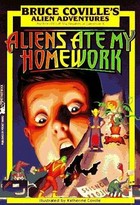
Review - Aliens Ate My Homework by Bruce Coville
Short review: Rod Albright is a nerdy clumsy kid afflicted by bullies. Then the aliens show up.
Haiku
Billy bullies Rod
Then aliens eat Rod's homework
Catch a criminal
Full review: Rod Albright is a kid with the typical troubles that afflict a lot of kids. He's overweight and clumsy, leading to his nickname "Rod the Clod". He is bullied by the class bullies Billy Becker and Arnie Markle. His single mother is overstretched in her commitments, meaning that he has the responsibility of watching his younger twin siblings Little Thing One and Little Thing Two. And he has a science project due. And then an alien ship crashes through his bedroom window, destroying his science project and handing him a whole collection of decidedly atypical troubles.
Having a spaceship crash through your bedroom window sounds pretty catastrophic, but in the case of the Ferkel, the ship is only two feet across, so other than a broken window and a crushed paper mache volcano, Rod's bedroom is mostly unscathed. After running afoul of Grakker, the ship's irritable two-inch tall captain, Rod isn't quite so lucky, getting a tiny hole in his ear. Once the Ferkel's diplomatic officer Madame Pong shows up, things get a little less tense. Rod learns that his unexpected guests are members of the Galactic Patrol on the trail of an interstellar criminal. Rod also finds himself involuntarily accorded the status of deputy and ordered to assist the crew of the Ferkel in their efforts to apprehend the fugitive.
After meeting the rest of the ship's crew, breaking regulations, and watching helplessly while the aliens carve up his volcano for fuel and food, Rod carries the Ferkel to a nearby field in order to allow the crew to use their size-altering technology to return the ship (and its crew) to their normal size. But when this doesn't work, Rod finds himself acting as an involuntary depurty again as part of the Ferkel's crew set about repairing the ship while Rod and the rest - Grakker, Madam Pong, and the ship's mental officer Snout, set off for Rod's school to try to get information about the criminal they are pursuing. Why Rod's school? Because in a massive coincidence, it turns out that the BKR, the criminal they are pursuing, is someone Rod knows.
Once at school, Rod runs into trouble with Arnie and Billy again, as Arnie spots the aliens Rod is carrying in his backpack. Mistaking them for toys, Arnie appropriates Grakker as his own. Grakker, being an alien and not a toy, returns to Rod's desk while the class is at lunch, and being hungry himself, eats Rod's math homework - which spawns the title of the book. of course, it also spawns more ire from Arnie directed towards Rod. But when Arnie tries to make Rod pay for the crime of Grakker disappearing from Arnie's desk, Snout comes to Rod's aid and Arnie ends up getting the worse end of the exchange. Through this section of the book, two themes common to Coville's books begin to come through clearly: (a) bullies will keep being bullies unless stood up to, and (b) the human race is cruel and barbaric and alien society is better.
But the story moves on as the crew of the Ferkel close in on their quarry. Well, they don't so much close in on their quarry as go stright to his house, discover who their real target is almost immediately, and then spend the rest of the book trying to apprehend him in zany action scenes. Along the way, Rod gets captured, shrunk to two-inches tall himself, has to deal with the kidnapping of his two siblings, and gets captured again. He also gets a tour of an alien ship, some new friends, and helps save the day. He also gets some help clearing up a few problems that he has had stemming from his interactions with his schoolmates.
In the end, almost every plot thread is wrapped up and everyone is happy (except, of course, for the villains). In fact, there is only one plot thread left hanging, which turns out to be the connection between Aliens Ate My Homework and the rest of the Alien Adventures series - and that plot thread is downplayed by the characters. It almost seems like Aliens Ate My Homework was originally conceived and written as a stand-alone book that was later revamped into the beginning of a series which makes it sort of like The Hobbit. As a result, while the book does kick off a really good series, it also serves up a very strong and enjoyable story on its own.
Subsequent book in the series: I Left My Sneakers in Dimension X
Bruce Coville Book Reviews A-Z Home
Thursday, September 1, 2011
Review - The Dinosaur That Followed Me Home by Bruce Coville
Short review: Summer camp - a time to deal with obnoxious counselors, time travel, thirty foot tall man-eating dinosaurs, and the end of reality as we know it.
Haiku
Travel to the past
Bring back some dinosaurs
No paradoxes
Full review: The Dinosaur that Followed Me Home is part of Bruce Coville's "Camp Haunted Hills" series featuring a summer camp dedicated to theatre and movie making where strange things seem to happen. The central characters, Stuart and Brenda, are a pair of campers who are the only two people at the camp who can see and hear the camp's resident ghost Roger. Roger is friendly and wants to be helpful, but also not real bright, so his "help" often causes more trouble for Stuart and Brenda.
Oddly, for a Coville book, there is no bully roaming about the make Stuart's life miserable. Instead, there is a jerk camp counselor named Flash who has a personal vendetta against Harry, a camp counselor that is friends with Stuart. (Flash dislikes Harry because Aurora, the most attractive female camp counselor, prefers the gawky but smart and sweet Harry to the handsome and cool but self-centered Flash). The book also introduces Brenda's cousin Winston to fill the position of the physically weak but smarter than everyone else kid.
The story itself is fairly simple, although at the same time enjoyably goofy and absurd. Flash sabotages several of Harry's projects, with Roger being the only one who sees him do so. Although Stuart and Brenda know about the sabotage (because Roger tells them), they can't really do anything about it because no one else knows about Roger. Eventually Roger takes things into his own hands and sends Flash back to the Cretaceous Period. Accidentally, Brenda, Winston, and Stuart all go too. Once there, they are beset with dinosaurs (fortunately, Roger can talk to dinosaurs), and when they find a way home they find they have been accompanied by three of the beasts.
Roger and Winston explain the rest of the group the dangers of creating a time-paradox (Winston using a classic example of doubling pennies on a chessboard to show how little changes can add up to big changes in short order), and the group has to figure out a way to send the dinosaurs home, while Flash decides that the dinosaurs have to stay so he can sell them to the highest bidder and make a pile of money.
The Dinosaur that Followed Me Home is a fast paced adventure story, and the characters are likable. The only trouble with the book is that there is a kind of forced atmosphere about it – it seems as though Coville tried to jam as many things into the story as possible: ghosts (who can talk to dinosaurs), time travel and time travel paradoxes, dinosaurs, a short-sighted teenage villain, and so on. The story still holds together, just barely, despite the weight of elements heaped upon it, but the book does still suffer somewhat. This is still a decent book for young readers, but it is simply too overloaded with disparate elements that don't hang together particularly well to be more than an average one.
Previous book in the series: Some of My Best Friends Are Monsters
Bruce Coville Book Reviews A-Z Home
Wednesday, August 31, 2011
Review - Some of My Best Friends Are Monsters by Bruce Coville
Short review: Stuart's life is complicated. His best friend is a ghost only he can see, the camp bully picks on him and turns into a monster, and he's being chased by a walking mummy. Just a normal summer at Camp Haunted Hills.
Haiku
Colton is a jerk
Glassman wants to make movies
Campers are monsters
Full review: In Some of My Best Friends Are Monsters, Coville continues the story of Stuart Glassman's sojourn at Camp Haunted Hills, a summer camp for kids that is run by the famous movie director Gregory Stevens which teaches kids film making, picking up where How I Survived My Summer Vacation left off. This installment continues the kitchen sink approach to storytelling that seems to be de rigeur for this series, with the campers joined by Roger the Ghost, a walking, talking Egyptian mummy, and a formula that transforms people into monsters. But the main story of the book is Glassman's conflict with the camp bully Lucius Colton, who seems to have taken an instant dislike to the nerdy and bespectacled Glassman.
The main conflict of the book is fairly simple: Colton hates Glassman and acts like a jerk - pushing him around, dumping food on his head, and destroying his property. Glassman explains that he's tried reasoning with Colton, fighting Colton, and otherwise getting Colton to get off his back, all to no avail. Roger, well-meaning but kind of dumb, tries to help by pulling a prank on Colton which more or less backfires, resulting in a mess that embarrasses Glassman's favorite counselor Harry Housen and that Glassman and his Brenda Conners have to clean up. And of course, despite being the result of good intentions on Roger's part, it does nothing to slow down Colton's persecution of Glassman.
Having a ghost who can go anywhere without anyone seeing him as a character allows Coville to throw in some story elements out of left-field, and he does. Roger tells Stuart and Brenda that a delivery made to Gregory Stevens' home was a real Egyptian mummy, and that one of the delivery men stole something from the mummy's case. Coincidentally this story is related to Stuart and Brenda immediately after they find a mysterious gold bug-shaped object on the ground near the trail to Stevens' house, although neither of them make the fairly obvious connection.
Because the book is only 106 pages, the story hustles along quickly . Colton tries to get revenge on Stuart by turning the tables and playing the trick Roger played on Colton earlier on the entire camp. Colton's plan is plan to let Stuart take the blame for the initial disaster and at the same time save everyone himself and get the accolades of being a hero. Through the application of some quick thinking, film special effects technology, and the unexpected intervention of a walking mummy, Colton's plan is foiled, Stuart saves the day, and everything turns out okay.
Well, sort of. Some of My Best Friends Are Monsters is the middle book in the series, and it shows in several ways. The most notable is that by the end of the book, the conflict between Glassman and Colton has resulted in a temporary triumph for Glassman, but remains unresolved. The book does not even include a message about being friends, or being nice, which makes it quite unusual for a Coville story. As a result, the book feels somewhat incomplete, and not much more than some funny filler in between How I Survived My Summer Vacation and The Dinosaur That Followed Me Home.
Previous book in the series: How I Survived My Summer Vacation
Subsequent book in the series: The Dinosaur That Followed Me Home
Bruce Coville Page Book Reviews A-Z Home
Sunday, August 28, 2011
Review - The Sandman, Vol. 4: Season of Mists by Neil Gaiman
Short review: Dream sets out to confront Lucifer, but finds the Prince of Hell has resigned and left him with a problem.
Haiku
Dream was once in love
But condemned her to rot in Hell
Lucifer retires
Full review: In volume four of the Sandman series, Gaiman reaches back and pulls at a thread that he first established back in Preludes and Nocturnes: Dream's less than successful love life, and his less than compassionate nature. Dream is, after all, one of the Endless, and indifferent at best to human concerns. Season of Mists uses as its backdrop one of the largest possible mythological venues possible: Hell. Despite a tale that deals with the rulership of the infernal domain, ultimately the story is one of personal choice and personal redemption.
But Dream is apparently not immune to human emotions and human pettiness. Because once long ago he fell in love with a woman named Nada, and she doesn't reciprocate. Or at least not in the way Dream expects that she will. And Dream's response to being spurned was to cast his lover in to Hell, a fact alluded to in Preludes and Nocturnes and expanded upon later. And so in this volume the Endless Destiny, spurred by a meeting with the Grey Ladies, calls upon his siblings to gather together: Death, Dream, Despair, Desire, and Delirium so they can meet and talk about nothing in particular. And this meeting results in Dream deciding that perhaps condemning his former love to millennia of torment in the depths of Hell was possibly uncalled for and a may have been mite unjust. This determined, Dream sets out to free his condemned lover from Lucifer's grasp, despite Dream having earned the Prince of Hell's animosity recovering one of the badges of his office in Preludes and Nocturnes.
On his way to Hell, Dream stops off and visits his one friend Hob who we first met in Dream Country. As he is Morpheus, he visits his friend in a dream, and Hob toasts him, with a slightly prophetic toast that gives this volume its name. This meeting blurs the line between dream and reality in a way that unsettles Hob, showing that even a man who has lived for centuries is not so jaded as to be blase when dealing with one of the Endless. Prepared for confrontation, Morpheus enters Hell, but finds it strangely quiet. He does not find Nada. He is instead met by Lucifer who tells the Dreamlord that he has tired of ruling Hell and is closing the place down. Having ejected all the condemned souls and demons from its environs, Lucifer takes Dream to close the last remaining Gates of Hell before asking him to sever his wings, an act that demotes Lucifer from the ranks of angels (or even fallen angels) and terminates his reign as ruler of Hell. But as he travels about Hell ejecting the last few heoldouts who refuse to leave and locking the remaining gates, Lucifer expounds upon theology, absolving himself of responsibility for the sins of mankind, and placing the blame squarely upon humanity's own shoulders. In this, it seems, Gaiman posits a decidedly humanistic vision of the world. And in one scene it seems that Gaiman is making a statement concerning the self-aggrandizement of humanity. Finally, Lucifer gets his revenge on Dream by handing the Key to Hell over to him. Dream, it seems, must choose the next ruler of Hell.
And Lucifer's gift to Dream does not go unnoticed as he is almost immediately beset by numerous suitors hoping to claim the now-vacated real estate. But first Dream speaks with his sister Death. She has little to say concerning his predicament, but she does reveal something of ominous import: the dead are returning to the Earth. And it only takes a second for the reader to realize it is not all the dead. Just those who had formerly been confined to Hell, a situation that certainly does not bode well for the living. Once again, Gaiman demonstrates his mastery of storytelling by delivering information to the reader subtly, and letting the reader put the pieces of the puzzle together rather than spelling everything out. Gaiman trusts his readers to understand subtlety, and as a result, his storytelling is that much more powerful. But soon the gods and powers arrive on Dream's doorstep: Odin recovers Loki from his underground torment and recruits Thor to keep Loki in line, the angels Duma and Remiel journey from the Silver City, and the demons Azael, Merkin, and Chonizon set out hoping to win their home back. They are joined by the Egyptian gods Anubis and Bast, the Japanese god Susano-o-no-Mikoto, Kilderkin the Lord of Order, Shivering Jemmy, a Princess of Chaos, and eventually Cluracan and Nuala of the Faerie Court. And each seeks the key to Hell, and each, it seems, has an offer to make to Dream.
But first the story returns to Earth to tell the story of a single unremarkable boy named Charles Rowland. In the midst of the tales concerning the disposition of Hell amidst the schemes and machinations of angels, gods, and demons, the story of an English schoolboy living a sad and lonely life as the only student left behind in between terms seems trivial and unimportant. But Charles Rowland is tormented by the spirits of the dead who returned from Hell and had nowhere else to go other than return to the boarding school where they taught, worked, or studied. And with nothing better to do, they repeat history, tormenting and killing Rowland just as they tormented and killed one of their own classmates a hundred years earlier. And it is this that drives home the true impact that Lucifer's abdication of his responsibilities has. When the damned are free to walk the Earth, they are free to inflict chaos and misery upon the living. The true cost of Lucifer's petty revenge upon Dream is shown in this seemingly unimportant interlude.
But the action then shifts back to Dream's domain, and the banquet he has offered his guests while he contemplates the disposal of the Key to Hell. And the reader gets treated to a view of the representatives of the various factions rubbing shoulders with one another; a hugely muscled, crude, and drunken Thor sloppily hits on the finicky Egyptian goddess Bast, Prince Cluracan of Faerie offers his sister Nuala as a gift to Dream and then stumbles off to a sexual encounter with one of the Egyptian delegation's servants, and all the while Loki observes all the other participants with a watchful eye, as do the two angels sent from the celestial city. Eventually, of course, each presents themselves before Dream to make the case that they should be handed the Key to Hell.
But what is more interesting than the threats, offers, and pleas is the background of events. As usual in the Sandman books, the things happening in the interstitial spaces of the story are the most interesting - the dinner's entertainment is the recurring character Cain, performing a magic act with his brother Abel in which he yet again kills his sibling. And turns him into sausages. Merkin and Azazel betray their companion Choronzon. Susano-O-No-Mikoto admits to petitioning Dream on his own, without the support of his pantheon. And in a single panel aside one of Dream's servants, a human experiencing Dream's realm in a dream-state, tries to connect with another. And so on. Each of these threads is not a part of the main story line of Season of Mists, but as usual with Gaiman's writing, one can be assured that most of them will become critical elements in later installments of the series.
And in the morning, we get a resolution of sorts. And as is often the case, the events happening in the background seem to suggest more than the main story. Nuala is awakened by her brother and in an aside says that all she hopes for is a good night sleep before chewing up some paper. Nuala's entire demeanor speaks of someone who has been sexually abused, with the implication that Cluracan may be the abuser. After wandering the halls of Dream's mansion and overhearing snippets of conversation from some other factions, Nuala comes to Dream's great hall and we see that the factions we have seen in the story make up only a portion of the petitioners seeking the Key to Hell (with the noted exception of the Greek gods, who apparently declined to attend). In the end the rule of Hell is determined, but not exactly as one might have foreseen. And once again Gaiman returns to the question of what purpose does Hell serve, and what role it's ruler must play - casting Lucifer once again in a sympathetic light and throwing doubt upon the justness of his exile. And Gaiman also makes a commentary on the nature of Hell, and why sometimes love is worse than hate.
But as usual, the important element of the story is not really the disposition of the Key to Hell, but rather the changes to the lives of the characters. And what the idea of Hell means. The faerie princess Nuala is surprised to learn that she was not merely a bargaining chip, but an unconditional gift to Dream. And we learn of Dream's dislike for illusions. As the representatives of the various pantheons depart, it turns out that at least one of them is not who he seems, and one ends up owing Dream a favor, a development that is certain to feature later in the series. And the story of Nada is resolved, although in a somewhat bittersweet manner, and with Dream once again tangling with one of the powers of Hell in the process.
Although by setting the story against the backdrop of the question of who gets to rule Hell, Gaiman runs the risk of the smaller and more important elements getting lost, I think that it allows him to highlight these story elements all the more. Because the stakes are so high for the various factions that desire the Key, they lay all their cards on the table and we are able to see what their fears and desires are, and everything that they would have to offer Dream. And we also get to see just what Dream does and does not care about - which often seems to surprise his petitioners as well. And we also get a glimpse of how this conflict affects the lives of the mere mortals who live in the shadows of the doings of the gods and the Endless, and this is, in my opinion, the touch that makes this series so good. It would have been easy to deal with the sweeping issues of the series, but it brings the events into much sharper focus to show what effect the doings of the mighty have upon the meek, and how petty and unfair the actions of the mighty seem when this is shown. The story, as a result, seems epic, but only until the implications of the squabbling of the players is shown, which makes this volume so much more compelling to read. Overall, Season of Mists is the strongest volume of the series thus far, and definitely worth reading.
Previous book in the series: The Sandman, Vol. 3: Dream Country
Subsequent book in the series: The Sandman, Vol. 5: A Game of You
Neil Gaiman Book Reviews A-Z Home
Friday, August 26, 2011
Follow Friday - Thirty-One Is a Happy Prime
It's Friday again, which means it's time for Follow Friday. There has been a slight change to the format, as now there are two Follow Friday hosts blogs and two Follow Friday Features Bloggers each week. To join the fun and make now book blogger friends, just follow these simple rules:
- Follow both of the Follow My Book Blog Friday Hosts (Parajunkee and Alison Can Read) and any one else you want to follow on the list.
- Follow the two Featured Bloggers of the week - Caught in the Pages and Jenni Elyse.
- Put your Blog name and URL in the Linky thing.
- Grab the button up there and place it in a post, this post is for people to find a place to say hi in your comments.
- Follow, follow, follow as many as you can, as many as you want, or just follow a few. The whole point is to make new friends and find new blogs. Also, don't just follow, comment and say hi. Another blogger might not know you are a new follower if you don't say "Hi".
- If someone comments and says they are following you, be a dear and follow back. Spread the love . . . and the followers.
- If you want to show the link list, just follow the link below the entries and copy and paste it within your post!
- If you're new to the Follow Friday Hop, comment and let me know, so I can stop by and check out your blog!
I love Tolkien. I think everyone knows this by now. So I want elves to return from the Undying Lands and declare themseves to be real. And when I say elves, I don't mean the long-blonde haired Orlando Bloom styles elves. I mean these guys:
![]() |
| If you don't tell me what I want to know, I'll imprison you for a hundred years |
![]() |
| We want the treasure, but we hate goblins more. |
Go to previous Follow Friday: You Can't Trust Anyone Over Thirty, Except Me
Go to subsequent Follow Friday: Thirty-Two is a Leyland Number Where X = Two and Y = Four
Follow Friday Home
Review - The Skull of Truth by Bruce Coville
Short review: A boy with passing familiarity with the truth acquires a magical skull that compels him and everyone around him to be completely honest, with disastrous results.
Haiku
Charlie steals a skull
And he has to tell the truth
Instead of lying
Full review: The Skull of Truth is part of the Magic Shop series of books featuring the mysterious magic shop of the mercurial Mr. Elives. As usual, the protagonist, a young man named Charlie, is beset with troubles - mostly involving his efforts to save the local swamp from development, and as a result he has been telling lies about the developer, who is the father of one of his classmates named Mark. In general, Charlie seems to have a hard time telling the truth, and as a result, nobody believes him.
As usual for these books, after a run-in with Mark, serving as the antagonist for this installment of the series, and his assorted gang members, Charlie finds himself in an unfamiliar part of his town standing outside Mr. Elives magic shop. Inside he meets the testy Mr. Elives and becomes enamored of a skull on display. Without understanding why, Charlie steals the skull, and his adventures begin.
Charlie later gets a message from Mr. Elives (delivered by his two talking rat messengers Jerome and Roxanne) warning him of the powers of the skull. It turns out the skull is the Skull of Truth (and also the skull of Yorick of Hamlet fame), and by asking it a question, Charlie opened up communication with it. The Skull can't tell a lie, nor can the owner. Eventually, anyone near it is compelled to tell the truth. Charlie soon learns the drawbacks of always telling the truth: first offending Gilbert, a friend of his recovering from cancer, and then revealing his affection for Karen, a girl in his class.
However, like most of the magic shop books, Charlie's magical McGuffin is intended to teach him a valuable lesson (even though Mr. Elives apparently didn't know he was going to grab it and run out of the shop, a twist new to the series), and through the rest of the book, he learns the value of being truthful with those around you. He learns how to ask for forgiveness, and his efforts to make up for harming Gilbert end up helping Gilbert more than he could have if he hadn't been truthful to begin with. Charlie also learns that when one tells people how you feel, it usually works out to your benefit in the long run. After a humorous scene in which Charlie's family airs outs all their family secrets (unknowingly under the influence of the Skull), Charlie figures out how to use the power of truth to save his swamp, and eventually reconciles with Mark.
The story has a cameo by Jennifer Murdley from Jennifer Murdley's Toad, although you have to be paying attention to notice it. The story has a few minor twists, and the eventual fate of the Skull and Charlie is somewhat unexpected, but not out of character for the Magic Shop books. Charlie ends up wiser for his experience, and a young reader will probably end up having thoroughly enjoyed the story.
Previous book in the series: Jennifer Murdley's Toad
Subsequent book in the series: Juliet Dove, Queen of Love
Bruce Coville Book Reviews A-Z Home
Wednesday, August 24, 2011
Review - Jennifer Murdley's Toad by Bruce Coville
Short review: A fun story about finding out what is important with a magical twist.
Haiku
Murdley's toad can talk,
And it's a pain in the butt,
But teaches her stuff
Full review: Jennifer Murdley's Toad is part of Bruce Coville's Magic Shop series. As with the other books in the series, a young protagonist comes across the Magic Shop and is given a magical gift that turns out to require them to become more than they had been to that point. In this book, the protagonist is a plain looking girl named Jennifer Murdley, and her magical gift is a talking toad named Bufo.
Jennifer is not an attractive girl, and is self-conscious about her appearance - wishing she were blonde and pretty. She is picked on by the popular, pretty girls, and finds herself in an unfamiliar alley with a magic shop. Inside, the odd proprietor sells her what turns out to be Bufo, the talking toad, for a pittance. As might be expected, Jennifer does not consider a talking toad to be something that will improve her position among her peers, and to make matters worse, Bufo is demanding and difficult.
Things go from bad to worse, as Jennifer discovers that a witch is after Bufo, a transforming curse affects Jennifer and her friends, and it proves difficult to keep her talking toad a secret from her brothers and the other people in her life. Jennifer must assume greater responsibility protecting both her toad and those around her, and must come to grips with her own insecurities.
The tale is basically a story about Jennifer growing up, and realizing that what she wants may not actually be something that is all that important. The story is told in a light-hearted humorous manner, although the villain is treated reasonably seriously, as Coville deftly avoids having her end up as a joke. despite the fact that the story is at times predictable, I was caught by surprise by the ending, although in retrospect all of the clues pointing towards the ending were embedded in the plot. Overall, this is a fun little book, well-suited to younger readers, with equal parts humor and adventure well-worth the time spent reading it.
Previous book in the series: Jeremy Thatcher, Dragon Hatcher
Subsequent book in the series: The Skull of Truth
1993 Mythopoeic Award Nominees
Bruce Coville Book Reviews A-Z Home
Review - Jeremy Thatcher, Dragon Hatcher by Bruce Coville
Short review: A fun, but not particularly noteworthy story about a boy who hatches a dragon's egg and raises a baby dragon.
Haiku
Jeremy likes art
Then he gets a dragon egg
And learns to like girls
Full review: Jeremy Thatcher, Dragon Hatcher is part of the Magic Shop series of books for young readers. The central character of the story is Jeremy Thatcher, an artistically inclined sixth grader who has the misfortune of being both small for his age and apparently cute enough that Mary Lou Hutton wants to kiss him - a prospect he finds horrifying. Despite his artistic talent, Jeremy is convinced that his art teacher hates him.
While fleeing from the proffered kisses of Mary Lou, Jeremy winds up on a street he doesn't recognize and wanders into the magic shop. Once there, he unknowingly buys a dragon egg, and begins the magical portion of the story. After he gets home, Jeremy finds instructions on how to hatch the egg, and later, how to raise his new baby dragon. Jeremy has to research dragons (with the help of a friendly librarian), come up with food to feed his new charge, and try to keep his new companion a secret.
As with most Magic Shop books, the addition of the dragon is presumably to help Jeremy learn something, but that element of this book seems to be somewhat poorly developed. There is a parallel between Jeremy having to give up on winning a school art contest and having to give up the dragon when it grows too large to continue to keep. There is also a related parallel between learning to love the dragon and learning to accept Mary Lou as something other than a yucky girl. Even so, there seems to be little urgency to the part of the plot.
Overall, there is little urgency in any part of the book. Jeremy's art teacher makes for a weak antagonist, as do the two less than impressive bullies Jeremy has to deal with, a contrast to the scary witch villain from (for example) Jennifer Murdley's Toad. The portions of the book that deal with Jeremy raising a dragon, and his joy in producing art are very good, but the book seems somehow incomplete, like only half of the story was written.
In the end, Jeremy Thatcher, Dragon Hatcher feels like it is half of a really good book. As a result, what is written is quite good, but left me frustrated and wanting the other half.
Previous book in the series: The Monster's Ring
Subsequent book in the series: Jennifer Murdley's Toad
1992 Mythopoeic Award Nominees
Bruce Coville Book Reviews A-Z Home
Monday, August 22, 2011
Review - The Monster's Ring by Bruce Coville
Short review: By discovering his inner monster, a bullied boy learns how to assert himself, but also learns to exercise restraint.
Haiku
Russell is bullied
A magic ring from Mr. Elives
Frees his monster self
Full review: The first of the Magic Shop books, The Monster's Ring is a story about growing up, facing your fears, and learning how to confront difficulties without losing your head. It is also a silly story about dressing up and having fun on Halloween.
Russell, the central character of the book, is a fifth grader who is fascinated by monster (owning a huge collection of monster comics) and even though some of his classmates say it is "kid stuff" is excited about the prospect of dressing as a monster for Halloween. To Russell's chagrin, his father doesn't listen to him, and his mother babies him. He is also tormented by the class bully Eddie. While fleeing his nemesis, Russell stumbles onto Mr. Elives magic shop, where the mysterious proprietor sells him "what he needs": a ring.
The ring, it turns out, is magical, and by following some instructions included with it, Russell can turn himself into a monster complete with fur, horns, fangs, and claws. The instructions also say that each turn of the ring will make the transformation bigger and scarier, but warns of possible side effects. Russell, of course, ignores this warning. Using the ring seems to have the side effect of making Russell bolder and more pugnacious, resulting in a fight with Eddie in the cafeteria and a confrontation with Russell's father that finally gets him listening to Russell.
Emboldened by his ability to turn into a scary monster, Russell decides to wear his monster shape as his costume for his class Halloween party. The "costume" is a big hit. Unfortunately, Russell finds himself acting in a most monster-like fashion, behavior he cannot control. The resulting trouble ends up in a confrontation with his mother in which Russell demands that she stop treating him like a baby.
Finally, on Halloween Russell takes the last step and transforms into a hideous winged creature. Halloween is also the night of the full moon, so the transformation is extra powerful. During the night, Russell finds Eddie being bullied himself, and comes to his aid, eventually learning to understand his adversary, and even begins to feel sorry for him. In the end, Mr. Elives comes to Russell's rescue, and all ends well except for the minor side effect that Russell seems likely to turn into a monster every full moon.
The story is, at its heart, a coming of age tale. Russell has to deal with growing up, changing from a little boy into a teenager (growing hair in odd places, uncontrollable urges, and increased assertiveness sure sounds like a boy starting puberty to me). He has to learn to balance his new assertive nature with a bit of sympathy and control, and that story is skillfully told with a humorous bent in this book. This is one of the few books aimed at kids about growing up that is subtle enough and funny enough that it seems to me that it would hold their attention.
My copy of The Monster's Ring is a revised version. In his afterward, Coville explains that when he wrote it, he did not anticipate writing more Magic Shop books. He later revised this book to include cameos from some characters from later books, but based upon his description I don't think that the revision affects the story in any significant way (I can't be sure, since I have not seen the unrevised version). Coville also likes to sneak in references to other books aimed at young readers: In the early part of the story Russell reads Bellairs' The House With a Clock in its Walls. Overall, this is a great beginning to a very good series of books for children, and highly recommended for any elementary school age child.
Subsequent book in the series: Jeremy Thatcher, Dragon Hatcher
Bruce Coville Book Reviews A-Z Home
Subscribe to:
Posts (Atom)