I have no sympathy for you whatsoever. You brought this on yourself. And every time you open your mouth, you just dig yourself deeper into the hole. After your non apology received such a cold reception, you'd think you'd have figured out that the villain in this piece is you. But no, rather than face up to the fact the being a serial copyright infringer makes you the source of all the problems you have faced, in what can only be described as an act of colossal hubris, posted this whiny defense of and attempted justification for your sleazy business practices. (Note: Cooks Source's website appears to have gone dark. I can only hope that someone thought to mirror their whiny rant before it vanished for all time). Not only that, you attempt to blame Monica for your woes, when the person you really should be pointing the finger at can be found by looking in a mirror.
You say that the problem is that Monica Gaudio contacted you when you were traveling all day and you were tired and overworked. I'm sorry, but that excuse just doesn't wash. This was not an aberration. Aside from your claim in your e-mail to her that everything on the internet is "public domain", and she should pay you for your slapdash editing hack job, it has become clear that misappropriating Mrs. Gaudio's work was not a mere oversight, but just one instance of a standard business practice for you. At this point, you have no credibility, having thrown it away by your repeated transparent lies and attempts to evade responsibility. You aren't even a very good liar, as evidenced by the fact that you've been caught red-handed in so many of them. Your attempted defense about "how" the article came to be in your magazine is laughable at best given the clear pattern of infringing that you have engaged in - and exposes that you remain ignorant of basic copyright law because copyright attaches to a work the instant it is produced, regardless of whether there is a copyright notice on it or not. Unless specifically noted otherwise, all work is copyrighted. I also find it amusing that you claim you were too "bleary-eyed" to type in an article from one of the multitude of books sent to you (which would have been copyright infringement in itself), but you apparently considered yourself bright-eyed and bushy-tailed enough to "improve" Mrs. Gaudio's article with some editing.1 You further indicate you have no idea how copyright works by insisting that by leaving Mrs. Gaudio's name on her work you didn't "steal" it. But by leaving Mrs. Gaudio's name on her work you merely avoided plagiarizing it, by publishing it without her consent you misappropriated it by violating her copyright.
As with everything else in your letter, your additional attempts at justification and empty and hollow. Your assertion that other writers have written for you for free is meaningless - you didn't do them a favor, they did you a favor - you cannot compel someone to do you a "favor" by misappropriating their work. The fact that foolish organizations send you books and press releases doesn't justify lifting other material. In fact, unless they actually gave you permission to reprint their content, it doesn't give you the right to reprint their stuff in your magazine even if they mailed you a copy. I notice that although you offer as a defense that a mean nasty reporter who "grilled you seriously" (and with good reason) was shown all of these promo books, and clip art, and the allegedly mean e-mails that Mrs. Gaudio sent you, you don't indicate what his reaction was? I'm going to go out on a limb and guess that is because he didn't accept these as any kind of justification for your sleazy, slimy, unethical , and illegal business practices and kept right on grilling you.
Your attempts to shift the blame for your troubles onto Monica Gaudino are odious. She did nothing wrong here. You claim she "blasted" you on the internet, but quite frankly, given your offensive conduct, she was quite tame in her reaction. Once again, your assertions about how she "didn't give you a chance" just don't carry any weight. You've got no credibility left remember? And as Mrs. Gaudio has been more than willing to put all of the exchanges she has had with you on the record, it seems that you've been caught in yet another lie. Your repeated plaintive whine that you paid her as she asked is particularly offensive, as it is clear that you only actually offered to pay her as a desperation maneuver to try to save yourself after it was clear that you were caught stealing from her and the personal consequences you would suffer as a result of being caught stealing were going to be unpleasant. The problems your magazine has had, and the supposed negative consequences your advertisers have suffered, have as their genesis only one source: You.
You complain that this has forced Cooks Source out of business. I can only say: Good. The world will be better off without a magazine that seems to consist primarily of misappropriated content run by a sleazy editor who thinks that she has the right to misappropriate other's work and then has the temerity to complain when there is a backlash against her misdeeds. You seem to think that by running a commercial enterprise you are somehow providing an irreplaceable public service. The simple truth is, your fly-by-night operation could probably be replicated easily if there really is a need for it, and by people who aren't crooks. Given that you misappropriated material from so many organizations, I suspect that you aren't going out of business because of the opprobrium you've received from irate netizens, but rather because of the mounting tidal wave of legal action you probably face from places like NPR, Food Network, and Disney.
You cannot shift the blame for this onto Mrs. Gaudio, or the evil denizens of the internet, or anyone else. The blame for all of the troubles you complain you have had heaped upon you since this whole fiasco began rests upon your head, and your head alone. The troubles you allege have been faced by your advertisers are because they associated themselves with your slimy publication. The communities you say you are so concerned about will suffer, to the extent that the loss of a business built upon criminal practices will cause them suffering, because of your actions. In the end, you are going out with an unconvincing, self-serving whine that is unlikely to convince anyone that you are anything but a thief who is only sorry she got caught. The only thing we can be certain of is that you are really only sorry you got caught with your hand in the cookie jar. Quite frankly, the world is better off with your magazine out of business and you on the unemployment line. I hope you have an extended stay there, and never work in publishing again.
1 As an aside, despite your repeated assertions about how experienced you are as an editor, I am amazed at the volume of grammatical errors in the material that you have put up on your website. For example, I'm not sure what this sentence is supposed to mean, "[w]hen putting together a magazine, a publishing firm usually has a staff of many, a stable of writers and proofreaders. Cooks Source doesn't, it is just us two . . . and believe me we would if we could use more help." If this is an example of your crackerjack editing, then not only should you be forced out of business because of your sleazy ethics, but also because your editing work is slapdash at best.
Biased Opinions Home
Wednesday, November 17, 2010


Tuesday, November 16, 2010
Review - Between a Roc and a Hard Place by Danny Birt

Short review: An orphaned dragon, a nest of Roc's, a morality play about living together and environmentalism.
Haiku
A baby dragon
Raised by rocs becomes a bridge
To protect the wild
Disclosure: I received this book as part of the LibraryThing Early Reviewers program. Some people think this may bias a reviewer so I am making sure to put this information up front. I don't think it biases my reviews, but I'll let others be the judge of that.
Full review: Between a Roc and a Hard Place is a cute little book that starts off as a kind of fish out of water story and ends up delivering a message about cooperation and environmentalism. Aimed at younger readers, the book is short, and a quick read to boot, which is both a strength and weakness for the book. Because it is short and quick, a younger reader is more likely to actually finish the book, but the story the author wanted to tell seems too large for the limited space it is packed into. As a result, some of the fantastical elements aren't explained well enough and a lot of the story development is presented in a manner that feels hurried.
The opening chapter shows the desperate attempts of a female dragon to save at least some of her unhatched offspring from the predations of a group of dragon hunters intent upon slaying her and her progeny. The chapter is actually the best done part of the entire book, putting the reader in the middle of the action, giving just enough information to give a clear idea what is happening without bogging the narrative down in extraneous detail. The problem I had with the book is that this doesn't last too much further into the book, which becomes increasingly about telling the reader about what the characters have done rather than showing them in action, glossing over large chunks of character and plot development. For example, a later critical plot development - the fact that a nearby human king is gathering forces to try to kill the main character - is related to the main character as a second hand retelling of a third hand rumor.
And this is a shame, because the broad strokes of the story are fairly interesting, even if the message, which ends up with the central character taking on the role of both the bridge between two (and eventually three) opposed groups and the world's most dangerous park ranger, is somewhat simplistic. Given the age range that this book is clearly targeted to, a simplistic message is probably what is called for, but it would have been nice to have just a little nuance in the story. Since the story is told in such broad strokes, almost all of the characters remain almost entirely undeveloped. The real weakness is that the fantasy elements are dropped into the mix without a whole lot of explanation, which seems to me likely to confuse readers of the intended age group. I also noted a couple instances of language that was probably too complex for the intended age group, such as a reference to "aviafauna".
As a whole, this book is only average. While the plot of the story is interesting, and there is a potentially really good young adult fantasy here, the weak character development and the extraordinarily broad brush used to deliver the story weakens the end product. If the characters and story had been more fleshed out, this could have been a brilliant book. In the end however, while the book is a decent little tale, but doesn't rise above that.
Danny Birt Book Reviews A-Z Home
Monday, November 15, 2010
Review - Rob Neyer's Big Book of Baseball Legends: The Truth, the Lies, and Everything Else by Rob Neyer

Short review: Rob Neyer fact checks numerous tall tales told by and about baseball players and finds many wanting and makes debunking funny and interesting stories funny and interesting.
Haiku
A good baseball yarn
Is fun and interesting
But often untrue
Full review: Baseball history is full of stories. The baseball yarn, usually told by an aging ex-player that begins with some variation of "there I was . . .", is a familiar and time-honored event. Every baseball fan can probably recount at least a half-dozen such stories from memory, if not more. Some of these stories have become treasured lore, woven into the mythology of the game. If you are a person who loves these sorts of stories unconditionally, then you should avoid this book at all costs. If, on the other hand, you are curious about the origin and veracity of these tall tales of the diamond, then this is the book for you.
Modern technology, by placing information at the fingertips of everyone from news reporters to your brother, has become the bane of faulty memories, puffery, and the tall tale. The availability of information can catch people in lies that change their careers, as Tim Johnson, former manger of the Toronto Blue Jays discovered when he was fired after it was revealed that he had lied about his service as a Marine in the Vietnam War. In Rob Neyer's Big Book of Baseball Legends: The Truth, the Lies, and Everything Else, Neyer turns modern technology (mostly databases of boxscores and newspaper records) to a less serious purpose: checking up on a number of colorful yarns told through the years about baseball and figuring out if they can actually be confirmed as true, or were just made up as entertaining anecdotes.
The format of the book is pretty straightforward. In some ways, the book is sort of like a Mythbusters for the baseball yarn. A baseball story is presented, usually with attribution to one or more sources. The potentially verifiable facts of the story are then identified. Then Neyer sets to work, combing through team rosters, boxscores, and contemporaneous newspaper accounts to determine if the story is potentially true, or if it simply doesn't match the concrete data. Each story gets the treatment, and most are examined to see if you slightly change the facts that they could match. If there are similar stories involving different players, different teams, or a different time and place, they are usually examined as well. The stories range from the obscure, like the first one in the book concerning a shower of boiling beans, or whether a Chinese player was in organized baseball in the 1920s, to more notable ones like Lou Gehrig's supposed impostor, to the most famous of baseball legends Babe Ruth's called shot. Each story is presented with quotes and anecdotes from players, managers, umpires, and reporters while Neyer tries to match all the often varying accounts of events against the known facts.
At first blush one might think a book devoted to using boxscores from 1956 to fact check some story told by umpire Tom Gorman would be dry and uninteresting, but Neyer keeps the writing light and conversational, making the pages roll by. The stories are drawn from a wide range of baseball eras, from the early 1900s all the way up to the 1980s. Some of the stories will no doubt be familiar to most baseball fans, while some will probably be completely unknown, and some of the fun of the book is reading these obscure baseball stories which are often quite entertaining, even if they stretch the truth a little (or, as often seems to be the case, quite a bit). So, for a baseball fan who doesn't mind if the legendary exploits of his boyhood heroes turn out to have been a little exaggerated, this is highly recommended.
Rob Neyer Book Reviews A-Z Home
Musical Monday - Fear the Boom and Bust by EconStories
Okay, so there's this long-standing philosophical conflict in the world of economics between John Maynard Keynes (author of The General Theory of Employment, Interest, and Money), the most famous economist of the twentieth century and possibly of all time, and F.A. Hayek (author of The Road to Serfdom and The Fatal Conceit), a relatively obscure, but highly influential figure who is mostly only well-known among economists. Well, Spike TV executive John Papola and George Mason University economics professor Russ Roberts teamed up to produce a rap video titled Fear the Boom and Bust that gives a surprisingly comprehensive account of the two contrasting views of the economy. The video, in which Hayek clearly wins the debate (this should be unsurprising, as Roberts is a proponent of the Austrian school of economic thought, which stems from Hayek's writing) shows Keynes engaged in a wild night of partying and drinking and Hayek serving up some harsh reality during the inevitable hangover the next morning. The video includes several nice small touches, including Hayek showing up with a metro pass while Keynes hires a limo, and the bartenders' name tags showing as Ben (and in Bernake) and Tim (as in Geithner). There is also a pretty good clip where John Papola discusses how the video was made at a meeting of the Mises Institute.
 |
| John Maynard Keynes |
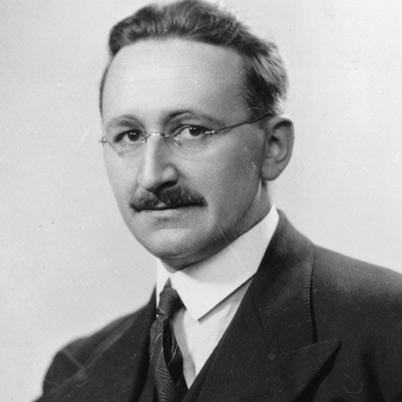 |
| F.A. Hayek |
"Prepare to get schooled in my Austrian perspective." - F.A. Hayek
Previous Musical Monday: The Arlington Rap by Remy Munasifi
Subsequent Musical Monday: We Are All Connected by Symphony of Science
EconStories Musical Monday Home
Sunday, November 14, 2010
Review - The Far Side Gallery 3 by Gary Larson

Short review: Another large collection of the weird and funny single panel comics with an introduction by Stephen Jay Gould.
Haiku
Cows! Insects! Lions!
An introduction by Gould
All seen off-kilter
Full review: The Far Side Gallery 3 is, as one might expect, the third omnibus collection of Gary Larson's very funny but always off-kilter comic strip The Far Side featuring the usual cast of cows, cavemen, nerds, insects and other strange denizens of Larson's twisted imagination. The single panel comics that make up the bulk of the book are the usual collection of weird but funny windows into a strange alternate reality where lions open car doors with coat-hangers to get at tourists and praying mantises argue over who ate whose husband. As usual for his collections, Larson recruited someone interesting to write the introduction to the book, in this case the noted scientist (and co creator of the theory of punctuated equilibrium) Stephen Jay Gould who merely introduces himself as a paleontologist and taxonomist who studies snails.
Though depreciating his own talents at humorous writing, Gould dissects why Larson is so popular among scientists, noting that by Gould's estimation 80% of the doors of his colleagues are decorated with a Far Side strip or two. Gould's introduction examines why this is the case, as he says, it isn't just the chuckles. And the fact that, as Gould notes, Larson has such a keep eye for reality and the weirdness that is just a hair away from reality that makes his strips so enduring. The idea of a cow in a hamster ball rolling about the house is funny because it is silly, but so is the idea of putting a hamster in a ball and setting him loose about the house. we just don't think about the silliness of the hamster in a ball until Larson makes us. Over and over again, Larson takes the mundane, rotates it slightly and gives us flies examining their garbage filled baby nursery or birds getting excited over cocktails served with skewered bugs or cavemen playing rock paper scissors before paper and scissors were invented. Almost every strip is funny, some will make you laugh out loud.
(As an aside, I only found one comic in this book to be not very funny. It is on page 181, and involves a brother playing a prank on his sister. There's nothing offensive about the strip, in fact it is just so boringly mundane that it seems like it should be filler in Family Circus rather than something in The Far Side).
The comics in this collection are from Larson's prime as a cartoonist, and it shows. The comics are almost all at least funny, and over and over again a strip will hit just the right comic note to make it hilarious. If you like The Far Side and its strange humor as I do, then this book is a must read.
Gary Larson Book Reviews A-Z Home
Saturday, November 13, 2010
Biased Opinion - Thomas Jefferson, Still Not On the Side of Religion in Government
 |
| Thomas Jefferson |
"I shall need, too, the favor of that Being in whose hands we are, who led our fathers, as Israel of old, from their native land and planted them in a country flowing with all the necessaries and comforts of life; who has covered our infancy with His providence and our riper years with His wisdom and power, and to whose goodness I ask you to join in supplications with me that He will so enlighten the minds of your servants, guide their councils, and prosper their measures that whatsoever they do shall result in your good, and shall secure to you the peace, friendship, and approbation of all nations."
This sounds pretty good for the pro-religious people. Until you actually read through the quote carefully. And until you read through the entire inaugural address. And then, as usual, the "the United States was based on a religious foundation" claims fall apart entirely.
First off, let's remember that Jefferson was giving a public speech as a public figure in a time in which a certain appeal to religion was expected. Leaving out a reference to God would probably have ended Jefferson's public career as a politician, and you can bet he knew that. As a counterpoint, I'd note that Obama spent about as much time in his inaugural address making appeals to God as Jefferson did in his, and somehow I don't think that the "conservative" rabble that wants to jam religion into every aspect of government is exactly lining up to extol Obama's inaugural address as a high point in religious sentiment.
We can also take note of the fact that this was Jefferson's second inaugural address. But what did Jefferson say about religion in his first address? Well, he made a fairly oblique reference to the blessings of providence as part of an overall listing of the benefits enjoyed by the country resulting from geography and the good character of the citizenry:
"Kindly separated by nature and a wide ocean from the exterminating havoc of one quarter of the globe; too high-minded to endure the degradations of the others; possessing a chosen country, with room enough for our descendants to the thousandth and thousandth generation; entertaining a due sense of our equal right to the use of our own faculties, to the acquisitions of our own industry, to honor and confidence from our fellow-citizens, resulting not from birth, but from our actions and their sense of them; enlightened by a benign religion, professed, indeed, and practiced in various forms, yet all of them inculcating honesty, truth, temperance, gratitude, and the love of man; acknowledging and adoring an overruling Providence, which by all its dispensations proves that it delights in the happiness of man here and his greater happiness hereafter—with all these blessings, what more is necessary to make us a happy and a prosperous people?"
Things look pretty good for the pro-religious foundation people now, don't they? They should bask in the glory right now, because it's going to be a short-lived moment for them. You see, in both of these quotes, Jefferson is not talking about the government, he's talking about the citizenry. So what happens when Jefferson talks about the government you ask? Well, in his first address you don't have to look far, because he tells you what he thinks the role of the government is in the two sentences immediately following the one I just quoted. He says:
"Still one thing more, fellow-citizens - a wise and frugal Government, which shall restrain men from injuring one another, shall leave them otherwise free to regulate their own pursuits of industry and improvement, and shall not take from the mouth of labor the bread it has earned. This is the sum of good government, and this is necessary to close the circle of our felicities."
Notice that he says this is the sum total of good government. Not to involve itself into religion, or moral issues, or anything other than preventing people from hurting one another and leaving them otherwise free to do whatever they want. But things get worse for the religious foundation proponents, in Jefferson's second inaugural address. Remember that paragraph I quoted near the beginning of this post? Jefferson is calling for people to pray that the officers of the government will be wise in fulfilling their duties in office, a call for private prayers made by private citizens. But what does Jefferson say about the involvement of the government in the area of religion? Well, he toes the Constitutional line set forth in the First Amendment and which he defined as a "wall of separation between church and state" in his famous letter to the Danbury Baptist Association:
"In matters of religion I have considered that its free exercise is placed by the Constitution independent of the powers of the General Government. I have therefore undertaken on no occasion to prescribe the religious exercises suited to it, but have left them, as the Constitution found them, under the direction and discipline of the church or state authorities acknowledged by the several religious societies."
In short, it seems that Jefferson was comfortable speaking about private religious observances when making a public speech in an era in which this sort of pronouncement was expected. However, when it came to mixing government and religion, Jefferson was cognizant of the fact that seems to elude many "religious conservatives" now - that the United States, from its inception, has held to a policy that divides government and religion. On this point, Jefferson was quite clear, and no amount of jumping up and down can change this.
The Founding Fathers steered quite clear of any implication that the two should be joined, probably because they understood, as the religious right seems not to, the danger to religion that mixing the two would pose. Think about it: From the perspective of the non-believer, putting religion into government merely involved injecting silly and meaningless superstition into the public sphere. But if you are a devout member of a particular faith, inserting religious teaching or practices into government could very well mean legally mandating that you participate in heretical practices. For a nonbeliever, it is an inconvenience. For the religiously observant, it is potentially an anathema. For this reason I am always befuddled when people with strong religious convictions agitate for religion in government. If you are religious, the last thing you should want is government involved in religion. Before you decide to put government into the business of religious ideas, you would do well to remember this quote, from our first President:
"Government is not reason, it is not eloquence, it is force; like fire, a troublesome servant and a fearful master. Never for a moment should it be left to irresponsible action." - George Washington
Biased Opinions Home
Friday, November 12, 2010
Review - The Demolished Man by Alfred Bester

Short review: Murder is impossible in a world with telepaths, but a man tries anyway.
Haiku
Ben Reich is insane
Says Tensor, said the Tenser
Is caught, demolished
Full review: In 1953, the first set of Hugo Awards were handed out. The first novel to win the Hugo was The Demolished Man, by Alfred Bester. Though some might quibble that Simak's City or Sturgeon's More Than Human are better books, The Demolished Man is, in my opinion, an instance in which the Hugo went to the right book. The novel is a murder mystery set in a future full of telepaths in which murder, or any other serious crime, has become effectively impossible because anyone who formed an intent to commit such a crime would give themselves away before they could commit it and be considered to be mentally insane.
Eight, sir; seven, sir;
Six, sir; five, sir;
Four, sir; three, sir;
Two, sir; one!
Tenser, said the Tensor.
Tenser, said the Tensor.
Tension, apprehension,
And dissension have begun.
But Ben Reich, the owner of Monarch, an enormous industrial conglomerate is locked in a struggle with his bitter rival Craye D'Courtney, the owner of the D'Courtney Cartel - a struggle that Reich knows he is losing. Pursued in his dreams by the Man with No Face, Reich determines to do the impossible, and murder Craye and then do something much harder - get away with it. Reich turns his vast fortune towards the task, setting events in motion to hide his efforts to accomplish his deadly task and cover his tracks, including placing the "Tenser, said the Tensor" repetitive jingle into his head that becomes a recurring theme of the novel as Reich focuses on it whenever confronted by a telepath, or as they are often called in the book, a "peeper".
The events of the book move at a rapid clip, with little wasted time spent on exposition or explanation. At the same time, Bester is able to work in such extensive background that this book influenced the depiction of telepaths in a vast array of subsequent science fiction works, most notably the Babylon 5 television series. One would note that it is no accident that the most prominent telepath in the Babylon 5 was named Alfred Bester. The Psi Corps itself was clearly inspired by the Esper Guild, although the Esper Guild as described in The Demolished Man is much more benign than Babylon 5's Psi Corps. The Demolished Man influenced Babylon 5's depiction of telepaths in so many ways - including the numerical rating of telepaths, and the conflict between telepaths and "normals" ("normals" would be those of us who do not have telepathic abilities), the hunt of latent telepaths, genetically approved marriage requirements for telepaths - that listing them all would take forever and so would listing the number of science fiction works that have also been influenced by Bester's book. Just to give one more example, the idea of preventing crime before it takes place shows up in Philip K. Dick's short story The Minority Report (which was the basis for the film The Minority Report). In short, if you've read a science fiction book that features telepaths that was written in the last fifty years, at least some part of it can probably be traced back to something that first appeared in The Demolished Man.
The bulk of the book follows the cat and mouse game between Reich and the telepathic police commissioner Lincoln Powell. Powell knows almost immediately that Reich is the man he is after, but because telepathic evidence is not admissible in court proceedings he has to build his case against Reich by more conventional means. The only real weakness in the plot of the book is that Bester establishes that Powell must prove Reich's motive to be able to secure a conviction against him, a point that becomes critical to the plot. This was somewhat grating to me, because while motive is usually a nice bonus for a prosecutor to establish, it is in no way required to prove motive in order to convict someone of a crime. Bester's overarching plot relies upon this, however, and while this bit of legal silliness is mildly annoying, it is necessary for the story to work, and can be forgiven on that basis. The novel, in many ways, is so tightly constructed that there is essentially no wasted material - if something shows up as a background detail early in the book, it eventually becomes an element of the plot. Bester also never over explains, trusting the reader to put connections together on their own, making the book almost a case study in how to build science fiction background without weighing down the story with clumsy infodumps. Even the concept of "demolition" is not explained for much of the book, even though it is referenced from the very start. Preserving some mystery about these sorts of elements makes them more ominous: all of the characters agree that demolition is something to be avoided, and their fear gives it power that an early explanation would have drained away.
The book is, however, not perfect. It has a couple of other minor problems resulting from being written in the early 1950s. It relies too much upon the now mostly discredited Freudian conception of the human personality, and the women in the book fill decidedly 1950s era roles as secretaries, wives, harlots, or damsels in distress. Some of the supposedly advanced technology seems fairly laughable today, such as a computer that feeds out piles of typed paper as its only output method, but that is true of almost all older science fiction. On the other hand, Bester's conception of a future society seems quite forward thinking in other ways which keeps the book from suffering too badly in the aging department. Bester's tendency to avoid over explanation is carried too far in some places - late in the book Reich takes on increased personal importance for reasons that are only half explained in the book and could have been improved if they had been expanded upon. Finally, Powell, who had spent the whole book adhering to the highly idealistic precepts of the Guild for the bulk of the book, throws those ideals over the side for a while towards the end of the story. This development only hints at the potentially sinister nature of the Esper Guild (a hint that J. Michael Straczynski followed up on in Babylon 5), which was kind of disappointing as it would have been interesting to see Bester himself follow up on this potential thread.
Overall this is a very strong work of science fiction, that has held up quite well despite its age. Coupling a rapid moving mystery with strong but unobtrusive world building, Bester delivers a vision of the future that remains a compelling and enjoyable story in spite of the handful of cracks that have developed over the years. Anyone who is interested in a gripping science fiction murder mystery, or who is interested in reading a story that is part of the roots of modern science fiction, or who is just interested in a really good story, should pick up this book.
What are the Hugo Awards?
Hugo Best Novel Winners
Alfred Bester Book Award Reviews Book Reviews A-Z Home
Review - Fantasy & Science Fiction: Volume 119, No. 1 & 2 (July/August 2010) edited by Gordon van Gelder

Stories included:
Advances in Modern Chemotherapy by Michael Alexander
The Revel by John Langan
Mister Sweetpants and the Living Dead by Albert E. Cowdrey
Pining to Be Human by Richard Bowes
The Lost Elephants of Kenyisha by Ken Altabef
The Precedent by Sean McMullen
Recrossing the Styx by Ian R. MacLeod
Brothers of the River by Rick Norwood
The Tale of Nameless Chameleon by Brenda Carre
Epidapheles and the Inadequately Enraged Demon by Ramsey Shehadeh
Introduction to Joyous Cooking, 200th Anniversary Edition by Heather Lindsley
Poems included:
Physics by Annabelle Beaver
Science fact articles included:
How Low Can You Go? by Paul Doherty and Pat Murphy
Full review: The July/August issue of Fantasy & Science Fiction provides the reader with a varied array of stories, but drawn into a couple of broad themes. Four stories read like Twilight Zone or Outer Limits episodes in print form. Two excellent stories, one fantasy and the other science fiction, deal with the threat of global warming, two fantasy stories are heavily Asian influenced, and the issue is capped off with two humorous stories. As seems to be the case in many issues of genre magazines, there is also a story that doesn't seem to actually fit as a genre story at all, which is always frustrating. However, with that sole exception, the stories in this issue are all pretty good.
Mentioned on the cover, Recrossing the Styx by Ian R. MacLeod is the most Twilight Zone-ish story in the issue. The story is told from the perspective of a cruise line employee in a future in which those who can pay can extend their lives and even return from the dead so long as they have the cash to pay for the myriad of advanced procedures necessary. He falls in love with a beautiful woman married to an elderly, wealthy man, and conspires with her to free her from this situation while retaining access to wealth. All goes well until the Twilight Zone twist at the end, which, even though it is a little easy to spot coming, is still a somewhat creepy resolution to the story. Advances in Modern Chemotherapy by Michael Alexander also seems like a Twilight Zone episode, as elderly cancer patients begin displaying paranormal powers in their last days before they die. The story posits a cruel irony that only those who are advancing quickly towards death gain these abilities, making it very difficult to study them or figure out why it is happening. The story is well-done, both making the reader feel the tired sickness of the patients, and the joy and confusion they feel as they test their new abilities. As a side note, with the baby boomers moving into old age, it seems likely that more and more science fiction stories will deal with the effects of aging, so I suspect we'll see more and more stories like these in the future.
The other two Twilight Zone type stories in the issue are more horror themed than science fiction. The Revel by John Langan is one of the best stories in the issue and tells a fairly typical werewolf tale from the perspective of an outside narrator who is openly aware of the conventions of the genre, shifting from character to character as the story goes. With the typical cast including a small town sheriff, local weirdo, hapless victims, and of course, the werewolf, Langan weaves a fast moving and compelling story that moves towards the twist ending that both seemingly crops up from nowhere and fits the story perfectly. The other horror story in the issue is Mister Sweetpants and the Living Dead by Albert E. Cowdrey, a modestly comic zombie story involving a wealthy writer and his dead ex-boyfriend who is stalking him. The story is told from the perspective of the owner of a security company hired to protect the writer, and it is both creepy and somewhat funny. Of the stories I have described as being reminiscent of the Twilight Zone, this one is the least Zone-like, but it is still quite good.
One of the strengths of this issue is that it deals with a variety of topics from a variety of angles. The global warming story has become more and more popular in science fiction, but both The Lost Elephants of Kenyisha by Ken Altabef and The Precedent by Sean McMullen are strong enough to stand out in the crowded field. The Lost Elephants is a fantasy story set in Kenya, at some undefined point in the future, featuring a scientist struggling to preserve the elephant as a species in the wild. Strange events in Tanzania lead the Tanzanian government to lift a ban on hunting, and with the aid of a British psychic and an African witch-doctor, the mystery of the elephants is unraveled in an unsettling conclusion. Although The Lost Elephants is quite good, it is overshadowed by The Precedent, which is by far the best story in an issue full of good ones. Set in a future that feels very plausible, The Precedent focuses on what the societal reaction might be if global temperatures soar. The result is a society that has deluded itself into thinking revenge is the same as justice, and in which all people born before the "tipping" (or the millennium) are guilty until proven innocent of crimes against humanity such as driving SUV's, using their hose to clean leaves, or just watching a lot of TV. The story focuses on the trial of an elderly climatologist - all of the defendants are old, all of the prosecutors are young as climate change has divided the generations - and his efforts to demonstrate his innocence to the various charges brought against him. The story is chilling, both for the vision of the planet that it describes, and for the callousness of the legal system that this has created. There is a little implausibility in the story: it is hard to believe that a younger generation would turn on their own parents and grandparents so viciously, but this only serves to heighten the tension. On the whole, it is an excellent story.
The issue also has its almost obligatory examples of Asian themed fantasy which will probably both remind readers of tales from 1,001 Nights. The first, Brothers of the River by Rick Norwood concerns two magically inclined brothers with very different demeanors who challenge one another to a race of epic proportions. They both have adventures along the way which allow them to overcome later challenges and eventually, as in many fairy tales, their race becomes an explanation for a terrain feature. It is a decent read, but nothing really special. The Tale of Nameless Chameleon by Brenda Carre is a story set in a city that seems at times like it would fit in ancient China, and at others like it would make a good proxy for a medieval Baghdad in which magic was real. The story itself is a classic revenge story, with a hardscrabble protagonist angling to get revenge upon the man he holds responsible for the death of his only friend. The method of revenge (and the price the protagonist must pay) are unusual, and the resolution seems to tie the story in a strange way to the Arthurian legend, although not so tightly as to be annoying. The protagonist is interesting, the setting is colorful, and the plot is good, all of which adds up to a good story.
The first of the two out and out humor stories sees the return of the incompetent wizard Epidapheles and his invisible chair familiar named "Door" in Epidapheles and the Inadequately Enraged Demon by Ramsey Shehadeh. The story takes Epidapheles and his weary and not very happy companion to a demonic realm where they are confronted with the demon of the title. The story is convoluted, and since Epidapheles is involved, quite strange while still being quite funny. The other humorous story, Introduction to Joyous Cooking, 200th Anniversary Edition by Heather Lindsley, is a short and funny piece imagining The Joy of Cooking a hundred and fifty years from now, discussing the new recipes that have been added to the book, and the old ones that were taken out. It is quick, light, and funny.
For some reason the editors of genre magazines seem to think putting a non-genre story in their magazine is a good idea. Maybe they think this will earn them literary credibility. Maybe they think their readers want some non-genre material. Maybe they have some other reason. I don't know the answer. Pining to Be Human by Richard Bowes is an example of this phenomenon. The story features a gay protagonist in the 1960s struggling with his sexuality in a society that regards being gay as an abomination, and as a result struggling with life in general. he struggles through college, uses a lot of drugs, has some not very happy relationships, and tells all of this to his therapist that he can afford by doing nude photo shoots. The "fantasy" element to the story is his visions of a set of witches from a play he saw when he was a young boy that featured a witch boy marrying a human girl - the boy is "pining to be human", which serves as a metaphor for being gay and yearning to be straight. The story isn't bad in and of itself, but there is no fantasy and no science fiction in it, which makes it out of place in this magazine.
The science fact article titled How Low Can You Go? by Paul Doherty and Pat Murphy is, as are most of the science articles in Fantasy & Science Fiction, a pretty bland affair. Although the subject matter of the article - the nature of absolute zero, how materials behave at very low temperatures, and other temperature related tidbits of information - might be useful to a very uneducated reader, most people who pick up a magazine heavily focused on science fiction will probably find the article an exercise in remedial learning at best. There is a running joke in the article about "contributing to the heat death of the Universe", but it gets pounded into the ground so much that it loses all humor value. The sad conclusion I have come to is that most of the science fact articles in Fantasy & Science Fiction are simply not worth the page count they take up in the magazine.
Overall, despite a weak science fact article and an out of place non-genre story, this issue of Fantasy & Science Fiction is really good. In fact, those two missteps are the only elements that kept me from rating this issue at five stars. While The Precedent is the best story in the issue, all of the stories are at least good, even Pining to Be Human. In the final assessment, this is simply a standout issue of a good magazine.
Previous issue reviewed: May/June 2010.
Subsequent issue reviewed: September/October 2010.
Gordon van Gelder Fantasy & Science Fiction Magazine Reviews Home
Wednesday, November 10, 2010
Review - DragonKnight: A Novel by Donita K. Paul

Short review: Bardon stumbles through a glacially slow quest without much thought. But that's okay because Wulder doesn't want you to think, you can just rely on him to fix everything for you.
Haiku
Bardon goes questing
Just by sitting on his ass
No real story here
Full review: Q: What would you get if you wrote a fantasy book filled with pseudo-Christian moralizing but left out anything resembling a real story?
A: You'd get the book DragonKnight.
The Dragonkeeper Chronicles trudge on in this third installment featuring Bardon, a secondary character introduced in DragonQuest (read review), the previous book in the series. The story moves at a glacial pace, filled with frenetic but pointless action that mostly has nothing at all to do with what little plot the book has, and which is periodically interrupted with bits of pseudo-Christian sermonizing that advocate a particularly passive way of dealing with life.
The primary problem with the book is that the plot is basically a haphazard collection of random coincidences strung together that flow by without the characters making any real decisions for themselves. The reason that the characters aimlessly stumble through the events of the book is that the religious message intended to be conveyed is clearly the idea that Wulder (standing in for God) has a plan for everything, and thus there are no coincidences, and the correct course of action is simply to trust in Wulder and everything will turn out okay. This particular piece of religious advocacy in favor of passivity results in a book in which the characters don't actually do much besides react to events as they pop up in front of them, and as one might expect, this makes for a fairly uninteresting story.
The plot of the book, such as it is, involves Bardon setting out on sabbatical for a year of solitude before he decides whether to dedicate his life to serving as a knight of Paladin. When he arrives at his designated sabbatical retreat, he discovers that two emmerlindian women, Granny Kye and her granddaughter N'Rae, and a minneken have taken up residence before him, and they have a quest that needs to be undertaken to boot.
"Wait", I hear you cry, "what the heck is a minneken"? Well, if you must know, it is a miniature race of beings that are somewhat similar in shape and size to a mouse that hails from the previously unmentioned Isle of Kye. This particular minneken, Jue Seeno, has been assigned as N'Rae's protector (although why N'rae needs a mouse-like protector is never really explained, and neither is how Jue was selected for the job). This, of course, runs counter to the assertions in DragonSpell (read review) that there are only seven high races and seven low races, and adding more races will somehow cause earth shattering disaster and signal the end of the world. But, given the introduction of the very humanoid meech dragons in DragonQuest, ignoring anything resembling continuity in world-building seems to be a common practice for Mrs. Paul. In short, what seemed like some clever world construction in DragonSpell turns out to have been just a convenient excuse for a plot MacGuffin, and was cast aside as soon as the MacGuffin was no longer needed.
Bardon, of course, cancels his plans to reflect on whether he wants to dedicate himself to Paladin's service, and instead agrees to help N'Rae find her long-lost father who was imprisoned by a spell cast by Risto that will expire and kill him when a particular comet reaches a particular spot in the sky. Apparently Risto would stop by and renew the spell keeping N'Rae's father in his enchanted slumber every now and then, but since he was killed in the last book he can't do that any more. Lest one stop and wonder why Risto would bother enchanting someone under a spell that he had to check back on periodically rather than just, say, killing them, Mrs. Paul throws in some random action to distract us, having Bardon fight a water snake and then a mountain lion before everyone heads out through the conveniently provided magical portal to a nearby city.
Once there, Bardon sets out to earn some money, and coincidentally there is a kindia breeder who needs several of the animals broken and is offering large sums of money to anyone who can. Like most other fantasy elements, the kindia, a sort of over sized horse with a sloped back and a temperamental disposition, are more or less dropped into the story as a plot device without any kind of foundation laid for their existence as an integral element of the fantasy world they inhabit. After Bardon spends a laborious day training a single kindia, it serendipitously turns out that N'Rae has a unique magical ability that makes taming the breeder's remaining stock a swift and easy process. The breeder, after some more plot extraneous action involving a kindia race, tries to rope N'rae and her special talent into his household by trying to get her to marry his son Holt. The characters kind of mill about randomly for a while, fighting random quiss or sea dragons when the novel slows down too much, getting arrested for stealing food for orphans, getting the orphans handed to their care as punishment, having Holt show up running from his creditors while trying to make passes at N'Rae and taking him in as a member of their crew because, as someone points out, they could use an extra strong body to help out on their quest, and he's handy. The strange appearances of quiss are set up as some sort of mystery involving vile experiments by the wizards Burner Stox and Crim Cropper, but this being a book in The Dragonkeeper Chronicles, this foreshadowing never leads to any kind of pay off in the story. (In point of fact, despite heavy foreshadowing, neither Burner Stox or Crim Cropper show up in the book at all).
The characters continue to drift along without any real urgency, despite the supposedly tight deadline they are on. As with previous books in the series, there's no problem so urgent that one cannot take time out to sit around and drink tea and eat cakes, or have philosophical discussions about how great Wulder is, or stopping to paint pictures. (Granny Kye, despite being an older emmerlindian, isn't very wise, but has the special ability to paint pictures that reveal a person's inner self. As with most fantasy elements of the book, this ability is pretty much useless in the context of the story being told and provides almost no benefit to her or anyone else in the book, despite it being harped upon constantly). This is, as we are told repeatedly, because Wulder has arranged everything according to his plan, and if one is intended to succeed in one's quest, it will turn out okay for you (and I suppose, if Wulder wants you to fail, you're pretty much screwed). So the characters pretty much just wander vaguely in what they assume is the right direction and hope for the best.
Along the way, random coincidences are seen as the hand of Wulder. Stittiponder, a blind orphaned street urchin who hears the wisdom of Wulder via voices only he can hear who had been very briefly introduced as a friend of Toopka's in DragonQuest, pops up thousands of miles away from where he was living on the streets in Vendela. Regidor returns to join Bardon's quest, although he arrives in response to a summons from Dar. Bardon literally stumbles across a gateway that transports him from the far northern tip of Amara almost on top of Kale, which pulls her into the quest serendipitously, and then drags along the wizards Fenworth, Cam, and Lyll as well as Librettowit, Taylaminkaydot, and Toopka, all of whom are introduced to the story using this incredibly clumsy plot device.
One of the few characters who Bardon and N'Rae actively recruit to join them on their quest to free her father, and one of the few who has specialized skills that could help them, is the mapmaker Bromptotterpimdosset, but since it turns out that he isn't theologically pure, they spend some effort trying to get rid of him. This illustrates that any semblance of plot that shows up in the story is clearly of secondary importance as far as Mrs. Paul is concerned. The important part of the book is providing "correct" moral instruction to the intended young adult audience, and that "correct" moral instruction is basically this: don't make any plans, because God will make everything work out for you, and don't associate with anyone who asks any hard questions, because they might pollute your mind with bad thoughts. Bromp serves up some straw men for Regidor and Bardon to shoot down, and is then converted to following Wulder when a random coincidence happens, because, of course, there are no random coincidences, there is only Wulder's plan.
So, the good guys eventually wander around enough and find the enchanted knights they were looking for by accident and then, well, they don't do much of anything for a while (remember, nothing is so urgent that you can't stop for a long lunch with tea and cake several times). Having spent no time at all trying to figure out how to break the enchantment until they found the knights, they meander about the abandoned fortress where they found them for a while until the answer drops in their lap. By that time, both the Pretender has shown up to cause trouble (but not too much trouble, since the characters are all under Wulder's protection and thus cannot be harmed), and Paladin shows up for a deus ex machina moment and everything is wrapped up in a nice bow - including the sudden revelation that Bardon is the son of one of the freed knights, Kale is the daughter of another, and Bardon and N'Rae are cousins (which conveniently solves the clumsy love triangle that Mrs. Paul has half-heartedly set-up between Bardon, N'Rae, and Kale in a manner reminiscent of the clumsy resolution of a similar love triangle in Return of the Jedi).
With the knights rescued, the random non-threats stop showing up and everyone is reunited with their family members. And in a huge anticlimax the wizard Fenworth permanently changes into a tree and Kale is dubbed the new Bog Wizard to replace him. Having milked about fifty pages worth of plot into a 393 page book, Mrs. Paul finally stops preaching the virtues of wandering aimlessly through life and expecting God, excuse me, I mean Wulder, to fix everything for you, and brings the turgid series of moral lessons to an end. With no real story, a pile of foreshadowing that never pays off, a completely random series of events, and a "moral message" that is pretty much a call to passivity, this book is definitely worth missing.
Previous book in the series: DragonQuest: A Novel
Subsequent book in the series: DragonFire: A Novel
Donita K. Paul Book Reviews A-Z Home
Biased Opinion - Was Dairy Goat Journal Simply Not Paying Attention this Week?
After the huge blowup over Cooks Source lifting Monica Gaudino's article without permission that seems to have essentially ended that magazine as a functioning entity one would think that other publishers would have taken note and realized that taking copyrighted material without getting the copyright holder's consent is illegal, unethical, and could very likely get the internet angry enough to overwhelm your website and destroy your business. Apparently, this message didn't get through to some people, because Dairy Goat Journal has been caught red-handed by Suzanne McMinn in the act of misappropriating one of her photos for their magazine.
I'm not going to go over copyright law again, since I did it in the original Cooks Source post, and anyone who wants to can just go read it there. The only difference between Mrs. Gaudino's story and Mrs. McMinn's is that one concerns printed text and the other concerns a photograph. Copyright law doesn't make a distinction between the two, however, so Mrs. McMinn is entitled to the same protections and has access to the same remedies as Mrs. Gaudino. Thus far, Dairy Goat Journal has also avoided making the outrageously stupid claims that Judith Griggs made concerning the nature of copyright law and the internet, but they have come close to matching Cooks Source for rudeness when caught with their hand in the cookie jar. Dairy Goat Journal also didn't even bother to give Mrs. McMinn credit when they reprinted her work. One also has to wonder if, like Cooks Source, the Dairy Goat Journal has made a practice of lifting material without permission and without attribution. I am cynical enough about human nature that I consider it likely that they have.
Mrs. McMinn says she will sue Dairy Goat Journal if necessary. I hope she doesn't have to and that the magazine will do the right thing, admit their error and compensate her fairly (including additional compensation to make up for their misdeeds), but if they don't, I really do hope that she sues them into oblivion. Publishers need to get the message: you can't take people's copyrighted work without their permission. One would hope that this message would get through without having to make an example of a couple by destroying them via massive statutory damage judgments, but I am not optimistic on that front.
In the interim, I encourage anyone who has the inclination to send an e-mail to the editors of Dairy Goat Journal giving them a piece of your mind on this topic. Their e-mail address (from their website) is [removed, because they later apologized and compensated Ms. McMinn]. Maybe if they get a couple thousand angry e-mails they will figure out that what they have done is wrong and won't be tolerated.
Biased Opinions Home
Biased Opinion - The United States Is Not Built on a Religious Foundation
There is a strain of thought floating about that the United States was founded upon a bedrock of religious principles (almost always asserted to be Christian principles) and that the Framers of the Constitution never meant for religion to be excluded from government. It is a proposition that is attractive to a lot of religious people. The primary problem with this strain of thought is that it is almost entirely unsupportable.
The argument rests on a foundation built from some fairly slender threads, and requires something of a misreading of these threads to work at all. The fundamental problem religious advocates have to overcome is that the U.S. Constitution, the foundational document of the country, doesn't mention "God", "Jesus", or a "Creator". The document only mentions "Lord" once in the date at the end of the document, phrasing the date as the "Seventeenth Day of September in the Year of our Lord one thousand seven hundred and Eighty seven", which is clearly not an invocation of religion but rather a commonly understood way to express a date. (There are a lot of things that are not in the U.S. Constitution that people claim are there).
The document only mentions religion twice - and both references are negative. First, Article VI, Section 3 of the U.S. Constitution prohibits any religious test for holding office. Second, the First Amendment contains the famous Establishment and Free Exercise Clauses that states that "Congress shall make no law respecting an establishment of religion or prohibiting the free exercise thereof". Clearly there isn't much direct support in the U.S. Constitution, so the advocates who claim that the U.S. was founded on religious principles have to turn to some pretty vapor thin claims.
The basic argument usually runs something like this: the Declaration of Independence says "[w]e hold these Truths to be self-evident, that all Men are created equal, that they are endowed by their Creator with certain unalienable Rights, that among these are Life, Liberty and the pursuit of Happiness.", and later makes an appeal to the "Supreme Judge" and seeks the "blessings of divine Providence". This, plus the assertion that the framers were deeply religious men is used as the basis for the claim that the United States is, in fact, built on a religious foundation. Sometimes you also see a claim that the preamble of the U.S. Constitution implements these ideas by stating that it is intended to (among other things) "secure the Blessing of Liberty", with the claim that the "blessings" must obviously be blessings from God. This argument is ill-conceived and not very convincing.
The initial flaw in this argument is that the Declaration of Independence, as brilliant a work of rhetoric as it is, is not any part of the law. It is, at best, an aspirational document. Nothing in the Declaration has any legal weight behind it. Citing it in a legal proceeding would likely get you laughed at. Secondly, the statements concerning unalienable rights have to be read in the context of the philosophical thinking of the time. Compare, for example, the "life, liberty, and pursuit of happiness" line penned by Thomas Jefferson with the similar statement written by Jefferson's intellectual ally George Mason in the Virginia Declaration of Rights:
"That all men are by nature equally free and independent, and have certain inherent rights, of which, when they enter into a state of society, they cannot, by any compact, deprive or divest their posterity; namely, the enjoyment of life and liberty, with the means of acquiring and possessing property, and pursuing and obtaining happiness and safety."
Both of these very similar statements justifying the reason for government are built upon arguments made by John Locke in his Two Treatises of Government, an expression of the philosophical thinking described as "natural law". In fact, both Mason and Jefferson's lines are rough paraphrases of a statement made by John Locke in his "A Letter Concerning Toleration" written in 1689 in which he states "[c]ivil interest I call life, liberty, health, and indolency of body; and the possession of outward things . . ." Locke built his theory upon natural law, asserting "[t]he state of Nature has a law of Nature to govern it", and further adopting the stance that the law of nature is reason.
Although natural law has been adopted by some religious traditions, asserting that as God is the fountainhead of nature, all natural law is derived from God, in its raw form natural law does not rely upon a divine being as its source. Instead, natural law is supposed to be derived purely from human reason, and in most formulations, rejects an external divine source out of hand. The line grasped at by those asserting a religious foundation for the United States is in actuality an assertion of the supremacy of human reason over revealed wisdom. Locke's political theory was founded on the idea of the social contract. Unlike Thomas Hobbes, Locke believed that human nature was built upon reason and tolerance. When left to their natural state, Locke believed that all people were equal and independent, and had a natural right to defend their “Life, health, Liberty, or Possessions", clearly the antecedent to the phrases used by Mason and Jefferson. Locke assumed that the sole right to defend in the state of nature was not enough, so people established a civil society to resolve conflicts in a civil way with help from government in a state of society. Note that this theory is devoid of reference to God or religion, but relies entirely upon human reason as a basis for government.
Further, imagining that Jefferson would make an appeal to divine authority as the source of human rights stretches credulity. Jefferson was openly hostile towards organized religion, and though he didn't come out directly and say it, Jefferson seems to have harbored some atheistic leanings. Just a small selection of Jefferson's quotes reveals his thoughts:
"Question with boldness even the existence of a god; because if there be one he must approve of the homage of reason more than that of blindfolded fear."
"History, I believe, furnishes no example of a priest-ridden people maintaining a free civil government. This marks the lowest grade of ignorance of which their civil as well as religious leaders will always avail themselves for their own purposes."
"The whole history of these books [the Gospels] is so defective and doubtful that it seems vain to attempt minute enquiry into it: And such tricks have been played with their text, and with the texts of other books relating to them, that we have a right, from that cause, to entertain much doubt what parts of them are genuine. In the New Testament there is internal evidence that parts of it have proceeded from an extraordinary man; and that other parts are of the fabric of very inferior minds. It is as easy to separate those parts, as to pick out diamonds from dunghills."
"Christianity neither is, nor ever was a part of the common law."
"As you say of yourself, I too am an Epicurian. I consider the genuine (not the imputed) doctrines of Epicurus as containing everything rational in moral philosophy which Greece and Rome have left us."
"To talk of immaterial existences is to talk of nothings. To say that the human soul, angels, god, are immaterial, is to say they are nothings, or that there is no god, no angels, no soul. I cannot reason otherwise: but I believe I am supported in my creed of materialism by Locke, Tracy, and Stewart."
These quotes should lay to rest any assertion that Jefferson had any kind of God bearing any resemblance to the God touted by most "America is a Christian nation" advocates in mind when he wrote the Declaration of Independence. I don't see how anyone could look at Jefferson's collected writings and think, even for a moment, that he would look favorably upon the efforts of people like Pat Robertson in their attempts to mix religion into government. Jefferson also wrote a revised version of the Bible in which he removed all miraculous and mystical elements that has come to be called The Jefferson Bible. And, of course, there is the famous letter Jefferson wrote to the Danbury Baptist Association in which Jefferson declares that the Constitution erects a wall to separate church and state:
"Believing with you that religion is a matter which lies solely between man and his God, that he owes account to none other for his faith or his worship, that the legislative powers of government reach actions only, and not opinions, I contemplate with sovereign reverence that act of the whole American people which declared that their legislature should 'make no law respecting an establishment of religion, or prohibiting the free exercise thereof,' thus building a wall of separation between church and State."
It is kind of humorous to see Jefferson's text in the Declaration of Independence cited by "Christian nation" advocated in favor of their idea that the United States is a Christian nation, but then see those same people usually turn around and decry the opinions Jefferson expressed in the Danbury letter and other writings. But I suppose that when you are rewriting history, coherence sometimes has to be cast overboard to make one's case.
Of course, Jefferson was only the primary author of the Declaration, the document was passed by the entire Continental Congress, so one could try to argue that many other legislators present were, in fact, voting in favor of a document that implemented a religious form of government. But the evidence for this is fairly thin. Most of the legislators that we know a substantial amount about were deists at most, and almost all were enamoured of the Enlightenment era theories of natural law that downplayed or outright rejected the active role that any divine being had in engendering natural law. The U.S. government, far from being built on a religious foundation, is clearly a vast experiment in bringing Locke's theories concerning government to fruition. Plus, as noted before, the Declaration isn't law, and is not the foundational document of our government. The U.S. Constitution is both.
As most people vaguely remember from high school history class, the Constitution wasn't the first governing document of the United States either. Eleven years separate the signing of the Declaration of Independence from the drafting and signing of the U.S. Constitution. During much of those intervening years, the United States was governed by the Articles of Confederation. Interestingly, the Articles include a fairly direct statement concerning God near the end of the document:
"And Whereas it hath pleased the Great Governor of the World to incline the hearts of the legislatures we respectively represent in Congress, to approve of, and to authorize us to ratify the said Articles of Confederation and perpetual Union."
So it is pretty clear that the legislators of the time knew how to make a direct reference to God in a governing document. But when the delegates convened for the Constitutional Convention that resulted in the current U.S. Constitution, they didn't see fit to include any similar statement in their new document despite having clear guidelines as to how this would be done. God is, in fact, notably absent form the document unless one inserts God as the originator of the "blessings of Liberty" in the preamble, and as we have seen already, this is an assertion that runs counter to the Lockean leanings of the founders. This absence of God in the Constitution wasn't an oversight, but clearly a deliberate omission. Highlighting this, consider that the delegates had the question of God put in front of them pretty early on in the process when Benjamin Franklin (one of only six people to be present for the signing of the Declaration of Independence and the Constitution1) proposed that the delegates open the Convention with a prayer suggesting that "henceforth prayers imploring the assistance of Heaven, and its blessing on our deliberations, be held in this Assembly every morning before we proceed to business." The delegates not only did not adopt this proposal, they declined to even bring it to a vote, immediately adjourned for the day, and the subject was never raised again. One can only reasonably conclude after this incident that the absence of God from the text of the Constitution was not an oversight, but a purposeful omission.
And soon after the Constitution was implemented, the government made a strong statement that it was not founded as a Christian nation. The occasion was a peace and trade agreement between the United States and Muslim leaders in North Africa. The negotiations were conducted during the presidency of George Washington, and the final document, known as the Treaty of Tripoli, was approved by the Senate and signed by John Adams, the second president. This treaty clearly states that the ". . . Government of the United States is not, in any sense, founded on the Christian religion . . . ." In short, we have two of the founding fathers making a pretty strong statement that there is no religious foundation underpinning the structure of the Federal government. It seems fairly clear that recent attempts to suggest otherwise are simply wrong.
1 The six men were: Robert Morris, Ben Franklin, George Clymer, James Wilson, George Read, and Roger Sherman.
Biased Opinions Home
Tuesday, November 9, 2010
Biased Opinion - Cooks Source Just Doesn't Get It
I have written previously about how Judith Griggs and Cooks Source misappropriated Monica Gaudio's article about apple pies and then Mrs. Griggs responded to Mrs. Gaudio's justified complaints by misstating copyright law, making an apologetic for plagiarism, and an obnoxious claim that she had "improved" the article with her unasked for editing and deserved compensation for that. Well, as one might expect, the internet dropped on top of Cooks Source and Judith Griggs, quickly overwhelming their Facebook page, inundating their advertisers with requests that they withdraw their support for Cooks Source, and uncovering multiple, repeated cases of Cooks Source lifting articles from numerous other sources and republishing them without the copyright holders' consent. Through all this, Cooks Source maintained a stony silence.
Well, today they finally issues what they probably think is an apology. (Note: Cooks Source has taken down their original apology and replaced it with an even sleazier "woe-is-me and blame the victim" post. A blog post by Lisa Gold that preserves some of the original apology text can be found here, and a humorous "corrected" version of the original apology that preserves all the original text in a roundabout way can be found here). I would call it a "non-apology apology". As with everything else that Cooks Source has done in this fiasco, they have shown yet again that they just don't get it. First off, the "apology" starts with four whiny paragraphs about how persecuted Cooks Source has been. That's right, the first thing they do in their "apology" to Mrs. Gaudino is talk about themselves and their trials and tribulations for four long paragraphs, including an appeal for people to "Report Abuse" to Facebook for people who have contacted Cooks Source's former advertisers. I'm not sure how they think that the "Report Abuse" link works on Facebook, but I'm pretty sure that they don't understand it. of course, this is the same crew that asserted that people who were posting negative comments on Cooks Source's Facebook profile were "hackers", so they clearly don't have a clue about much of anything.
After talking about themselves for a couple hundred words, Cooks Source moves on to "apologize" to Mrs. Gaudino, claiming that taking her article without her permission was an "oversight" resulting from overworked staff. Of course, the fact that they have been shown to be serial copyright violators makes that claim ring pretty hollow. Then, they try to cover up the fact that they were caught red-handed stealing Mrs. Gaudino's property by saying, "Monica was given a clear credit for using her article within the publication, and has been paid in the way that she has requested to be paid." This is like a thief offering to pay for stealing something only after he has been caught. Further, Cooks Source only paid up after attempting to stiff arm Mrs. Gaudino by asserting they were allowed to misappropriate her work. When a bank robber offers to give the money he stole back after he's been arrested, he doesn't get any praise, and neither should Cooks Source.
Cooks Source then announces that it is going to change its practices and actually follow copyright law by only publishing work that the original author has given them the right to publish. Then they try to weasel out of even that level of commitment by saying that they have a small staff and cannot check on every article and do the minimum amount of legwork checking to see if they actually have the right to publish something that every professional in the publishing industry accepts as the standard. They close with a mealy mouthed paragraph of whining about how this has damaged their business and a self-serving moan about how this has harmed their readers, all without admitting that the reason that their business has been damaged and their readers supposedly harmed were Cooks Source's own unethical and illegal practices. Their whining on this score is a little like a man convicted of murdering his own mother and father complaining that the judge is heartless for sentencing an orphan to prison.
Cooks Source finally closes by telling everyone to leave Monica Gaudino alone, although there has been no report that I have seen of anyone bothering her. They say she "did what she felt was the right thing", which is a long way from what she actually did - she did what actually was the right thing, and was far more tolerant of Cooks Source's illegal, unethical, and obnoxious behavior than they had any right to expect.
The end result here is that Cooks Source clearly still doesn't understand that what they did was not only wrong, but that it wasn't even a borderline case. They misappropriated property belonging to someone else, and when they came asking for a very modest amount as compensation for their misdeeds, they rebuffed her rudely. And then when this became public and they suffered in the shitstorm they had created for themselves, they had (and still have) the temerity to try to claim that they are the martyred victim. Through all of this Mrs. Gaudino has remained classy, for which I commend her. Cooks Source, on the other hand, has demonstrated that not only are they a sleazy and clueless organization, that they truly deserve the moniker "Crooks Source" that has been stapled to their foreheads.
Biased Opinions Home
Monday, November 8, 2010
Biased Opinion - A Senator Lies to You and Me

First he exposes a little bit of ignorance when says that raising the debt ceiling is like paying off your credit cards. It isn't. Raising the debt ceiling is like getting a raise on the limit on your credit card. The debt ceiling is, supposedly, a limit on the total amount that the Federal government can borrow. It is supposed to force Congress to exercise a little fiscal discipline by limiting the amount of debt the government can incur. But since Congress sets the debt ceiling and sets the budget, the reality is that the debt ceiling is more or less just a fictional number that gets moved when it is inconvenient for Congress.
This is really a minor peccadillo on DeMint's part. After misstating what the debt ceiling is, DeMint then says he won't vote to raise the debt ceiling unless that raise is accompanied by steps to reduce the deficit and move the budget into balance. And then things come apart for Senator DeMint. The major issue comes when interviewer Gregory David asks exactly how he proposes to reduce the deficit. He claims (among other things) that reducing Federal worker salaries and eliminating government waste will save "hundreds of billions of dollars". He says that we can do a lot of deficit reduction by cutting earmarks. He also says that there is no need to even think about making changes to social security, and proposes increasing the amount spent on medicare. This is all complete bullshit.
As I pointed out here, the non-defense discretionary budget is a relatively small proportion of total Federal spending. Even if you cut it all, the government would still run a deficit. The total cost of the civilian workforce for the Federal government is hard to estimate, since in addition to the salaries paid there are benefits to account for, which makes the calculations murky. I've seen a couple estimates, and the absolute highest I've seen is that in fiscal year 2010, the entire civilian workforce will cost about the Federal government about $260 billion. If you fired every Federal worker and reduced the amount spent on them to zero (you can't, a lot of benefits are for ongoing things like retirement benefits), you'd only save between about a fifth and a fourth of the total deficit. And that requires that you fire everyone. Including the President, every member of Congress, every federal judge, including all the Supreme Court justices, every FBI agent, every IRS agent (and if you fire them, who is going to collect the taxes to pay for everything anyway), every park ranger, every employee of the social security administration, every FDA food inspector, and, well, you get the idea. Just reducing the Federal workforce or cutting worker salaries would get you far less of a deficit reduction.1 In the overall scheme of things, probably a comparatively trivial amount.
DeMint's other two areas for reducing spending - eliminating government waste and getting rid of earmarks, are too trivial to even consider. The 2010 budget contains about $50 billion in earmarks. Which sounds impressive, until you realize that this amounts to 1.4% of the Federal budget. Government "waste" is always touted as a way to save lots of money, but realistically these concerns are always overblown. If one is generous then maybe a similar amount of money is "wasted" as is spent on earmarks (and defining what is and is not waste is a very murky subject to begin with). Even if you assume you can eliminate earmarks and waste entirely, you're saving, maybe $100 billion. And that assumes you eliminate them entirely.
This also assumes that by not earmarking money, you aren't spending it. All an earmark really is is directed spending. If the government is going to spend, say $50 billion on new airplanes for the Air Force, and a Congressman earmarks $1 billion of that to be spent in his district, all that truly means is that $1 billion of the money has to be spent in that Congressman's district. Eliminating the earmark could mean that the $1 billion in spending is also eliminated, or it could just mean that the total amount to be spent is now at the discretion of the appropriate executive agency officials (in this case, that would probably be the Secretary of the Air Force).
So even in the most optimistic scenario for Senator DeMint, he's saved about $350 billion or so. And that's if he fires everyone, eliminates all waste, and cuts all spending currently intended on earmarks. That still leaves a deficit of about $700 billion. Obviously, even that much budget cutting cannot happen using DeMint's targets (the government couldn't function with no civilian workforce after all), so the best he can reasonably hope for would probably be something closer to $100 billion, and then only if he makes some pretty draconian cuts to the Federal workforce and the pay of Federal workers. In which case, you've pretty much wrecked the economy of both Virginia and Maryland at least, because Federal workers do, in fact, spend their money where they live, feeding those dollars into the economy and helping fuel the prosperity of their region.
And you may have noticed that none of this gets us even close to making a dent of any real size in the $1.17 trillion deficit the Federal government is expected to run in fiscal year 2010.2 The simple fact of the matter is that mandatory spending - social security, medicare, medicaid, interest on the debt, and so on, makes up 60% of Federal spending in a typical year. And as the Baby Boomers age and retire and begin collecting social security and claiming medicare benefits, the dollar total of benefits that the Federal government is obligated to pay is only going to grow. Unless we take serious steps in multiple areas, the budget will never be balanced. We have to, among other things, raise more revenue, cut benefits, and reduce defense spending to have any hope of achieving a balanced budget. And even then it will be questionable if it can be done. And blowhards like Senator DeMint spouting complete bullshit and lying to everyone isn't going to help matters any.
1 For the record, the Federal government, in my self-interested experience, gets a great deal with respect to its employees. Yes, the average Federal worker gets paid more than the average non-Federal worker (although not anywhere near "twice what the average worker does"). We are also, on average, better educated and have more experience than our non-Federal counterparts. Anecdotally, I would make far more money in the private sector than I make as a Federal lawyer.
2 The fiscal year for the Federal government runs from October 1 to September 30. Each fiscal year is designated by the year it starts in. So the fiscal year that started last month on October 1, 2010, which will run until September 30, 2011 is fiscal year 2010.
Biased Opinions Home
Subscribe to:
Posts (Atom)